Guide
Celery Juice, Examined Properly
What celery juice is good for, what the popular claims actually rest on, and how to make it taste like something you want to drink.
As an Amazon Associate this site earns from qualifying purchases. Links to products may be affiliate links. This costs you nothing extra and does not change what gets recommended. Nothing here is medical advice.
Celery juice became a phenomenon on the strength of claims that ran a long way ahead of the evidence for them. That is a shame, because celery is genuinely one of the most useful things you can put through a juicer, and the useful reasons have nothing to do with the ones that made it famous.
This page covers what celery actually does in a glass, what the popular claims rest on, and how to make it taste good rather than medicinal.
What celery is actually good at
Three properties make celery the most practical juicing vegetable available, and none of them requires a health claim.
Yield. Celery is mostly water held in a fibrous structure that gives it up readily. A head of celery produces a surprising volume of juice, far more than the same weight of leafy greens, and at a lower cost per millilitre than almost anything else in the produce aisle.
Mildness. Celery juice is savoury, faintly salty, and green without being aggressive. That makes it the ideal volume base, since it carries other ingredients rather than competing with them. A glass built on celery tastes like whatever you added to it. A glass built on kale tastes like kale regardless of what else went in.
Availability and price. Celery is cheap, sold everywhere, and available year round. It keeps for a couple of weeks in a refrigerator. For anyone juicing regularly, this reliability matters more than any single nutritional property.
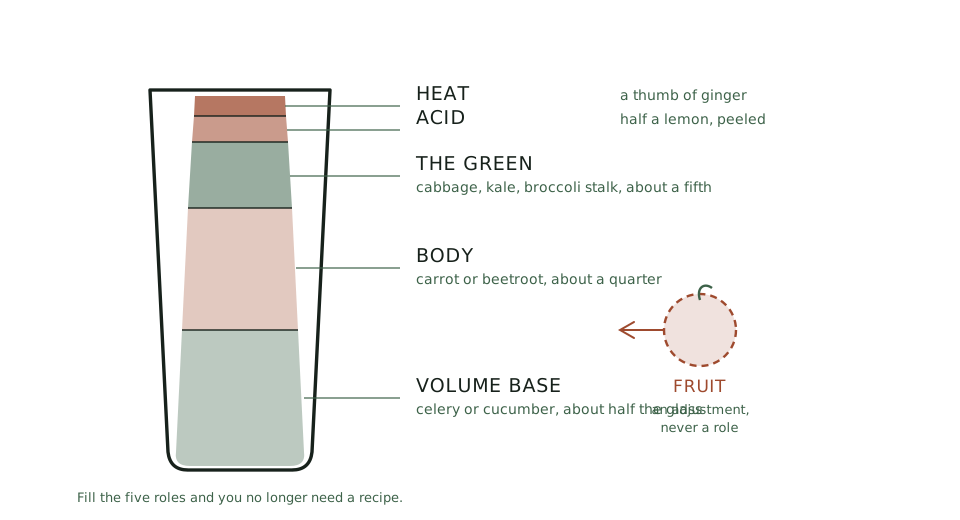
Those three together are why celery appears in the structure this site uses as the volume base, filling about half the glass.
The claims, honestly
Celery juice acquired a following through claims about detoxification, gut healing, and the treatment of specific chronic conditions. Being straightforward about this is more useful than either repeating or mocking it.
What is uncontroversial. Celery contains water, potassium, some vitamin K, and a range of plant compounds including flavonoids and phthalides, the latter being what gives celery its characteristic smell. Drinking a large glass of vegetable juice in the morning increases your vegetable intake and your fluid intake. Both are reasonable things to do.
What is not established. The specific protocols circulating online, which typically involve a fixed quantity of pure celery juice on an empty stomach at a fixed time, are not derived from clinical research. They originated in popular health writing rather than in trials. Claims about detoxifying organs, healing specific conditions, or curing chronic illness are not supported by evidence that would satisfy a clinician.
What is genuinely under study. Some compounds found in celery have attracted laboratory and animal research interest. That is a reason for continued investigation rather than a basis for a health claim, and the gap between a compound behaving interestingly in a dish and a food producing an outcome in a person is very large.
Nothing on this site is medical advice. Anyone drinking celery juice to address a specific health condition should be discussing it with a clinician rather than with a website.
The honest position is that celery juice is a good drink and a sensible way to consume vegetables. It does not need to be more than that to be worth making.
Pure celery juice, if you want it
Some people specifically want celery on its own, and it is worth knowing how to make that version well.
Sixteen ounces of pure celery juice takes roughly one large head. Wash it thoroughly, since celery grows in sandy soil and grit hides in the base of the stalks. Separate the stalks and rinse each one rather than rinsing the head whole.
Keep the leaves. They are more strongly flavoured than the stalks and they juice perfectly well. Discarding them wastes both yield and taste.
Cut the stalks into short lengths for a masticating machine such as a self-feeding horizontal cold press juicer, since long celery strings are the classic cause of a wrapped auger. The juicing hub covers feed technique in more detail, and cutting short is the single easiest prevention.
Pure celery juice is savoury and slightly saline. Some people like it immediately, and some find it difficult. If you are in the second group, the version below is a better place to start.
Making it taste good
The most common reason people abandon celery juice is that they drank it neat, disliked it, and concluded the whole idea was not for them.
Three additions change it completely, and none of them contradicts the point of the drink.
Lemon. Half a lemon, peeled. Celery is savoury and slightly flat, and acid lifts it immediately. This single addition converts the drink for most people.
Cucumber. Roughly one part cucumber to three parts celery. It softens the savoury edge and adds volume without adding sweetness.
Ginger. A thumb. It gives the finish something to be, and it works particularly well against celery's saltiness.
That combination, celery with lemon, cucumber, and ginger, is a genuinely pleasant drink rather than a task to be completed. If you want the celery-forward version without going all the way to a full mixed juice, this is where to sit.
Adding a green apple makes it easier again, at the cost of moving away from a pure vegetable glass.
The leaves and the base
Two parts of a head of celery get discarded routinely and both are worth keeping.
The leaves are more strongly flavoured than the stalks, closer to a herb than a vegetable, and they juice perfectly well. Use them in moderation, since a large quantity pushes the glass toward bitterness, but discarding them entirely wastes both yield and character. A handful in a full glass is about right.
The base, the pale solid piece the stalks grow from, is usually cut off and binned. It juices well once trimmed of any brown or soft parts and scrubbed properly, since it holds the most grit of anything on the plant. It is denser than the stalks and adds body.
Between the two, you recover a noticeable share of a head that most people throw away.
Where it fits in a mixed juice
For most people the better use of celery is as the base of a full glass rather than as a drink on its own.
In the standard glass used across this site, three sticks of celery provide about half the volume, with carrot for body, cabbage as the green, apple as an adjustment, and lemon and ginger to finish. Celery does the structural work and disappears into the result.
Feed celery between harder items rather than sending it all through at once. Alternating soft with hard raises yield noticeably, since the harder pieces press the softer ones against the screen.
Buying and storing celery
Choose heads that are tight and firm with the stalks held closely together. Splayed heads with loose outer stalks are older. The leaves should be present and green rather than yellowing.
Darker green celery is more strongly flavoured. Paler, blanched celery is milder and sweeter. For juicing, darker is usually better value in flavour terms.
Store it wrapped in the refrigerator. Celery wilts through moisture loss, and a head wrapped in foil or a damp cloth holds far longer than one sitting bare in a drawer. Limp celery can often be revived by standing the cut ends in cold water for an hour, and revived celery juices perfectly well even when it is no longer pleasant to eat raw.
This tolerance for slightly tired produce is another practical argument for celery. A head that is past its best for a salad is entirely fine in a juicer, which reduces waste noticeably.
Timing and quantity
The popular protocols specify sixteen ounces on an empty stomach first thing. There is no strong evidence for that particular arrangement, and there is also nothing wrong with it.
What matters more is that you drink it fresh. The two hour rule applies to celery as much as anything else, and celery juice in particular loses its brightness quickly.
Quantity is a matter of appetite rather than dosage. A glass alongside breakfast is a reasonable habit. Large volumes of any single vegetable juice are worth approaching with the same moderation you would apply to large volumes of anything.
One practical note: celery is naturally higher in sodium than most vegetables, which is what gives the juice its saline quality. Anyone managing sodium intake for medical reasons should factor that in and raise it with their clinician.
RUN THE NUMBERS
Illustrative figures only, based on typical produce, and not a promise about your results.
| Pure celery | Celery-led mixed glass | |
|---|---|---|
| Celery | One large head | 3 sticks |
| Additions | None | Cucumber, lemon, ginger, carrot |
| Yield | Roughly 16 oz | Roughly 16 oz total |
| Prep | 5 minutes, washing carefully | 4 minutes |
| Taste | Savoury, saline, divisive | Bright and easy |
| Best drunk | Within 2 hours | Within 2 hours |
Celery is among the cheapest inputs per millilitre of juice available, which is why it earns its place as a base regardless of any other consideration.
WHAT GOES WRONG
Grit in the juice. Celery grows in sand and holds it at the base of the stalks. Separate and rinse each stalk rather than rinsing the head whole.
A wrapped auger. Long stalks fed in whole. Cut into short lengths.
Juice that tastes unpleasantly salty. Normal for pure celery, and a sign you would prefer the mixed version. Add lemon and cucumber.
Bitterness. Usually old celery, or too many leaves in proportion. Leaves are good in moderation and assertive in quantity.
Losing interest after a week. Almost always because it was drunk neat and disliked. Rebuild it with lemon and ginger before giving up on the ingredient.
DO THIS NOW
- Wash the stalks individually rather than rinsing the head, and keep the leaves.
- Cut into short lengths before feeding, whichever machine you have.
- Make it with half a lemon, a length of cucumber, and a thumb of ginger before you try it neat.
- Drink it within two hours, or decant into six ounce jars filled to the rim.
Next
For the full structure that uses celery as its volume base, and the four other roles a glass needs filled, see green juice built on vegetables.
Celery juice loses its brightness faster than most. Juice storage and oxidation covers the two hour rule and what to do when it does not fit your morning.