Hub
Cold Press and Juicing at Home
How to build a vegetable-led juice, choose a machine that cleans in two minutes, and get more glass from the same produce.
As an Amazon Associate this site earns from qualifying purchases. Links to products may be affiliate links. This costs you nothing extra and does not change what gets recommended. Nothing here is medical advice.
Here is a glass that works, and it is the example this entire hub is built around.
Four carrots, a wedge of green cabbage, three sticks of celery, one green apple, a thumb of ginger, half a lemon. It takes about four minutes to make, it cleans up in two, and it goes alongside breakfast rather than instead of it. It is overwhelmingly vegetable, the apple is there for balance rather than for sweetness, and it tastes considerably better than that description suggests.
Call it the breakfast glass. It appears throughout this hub and in every guide beneath it, because one worked example you can actually reproduce beats a hundred variations you will never make.
Juicing has a reputation for being fiddly, expensive, and short lived as a habit. All three are avoidable, and the things that make them avoidable are specific rather than vague. This page covers them in the order they matter: what goes in the glass, which machine suits your routine, how to get the cleaning down to two minutes, and how to get more juice from the same produce.
What juicing actually does
A juicer does one thing. It separates the liquid fraction of a plant from the insoluble fibre, and everything else follows from that.
The liquid carries the water soluble contents of the plant cells, which includes sugars, organic acids, water soluble vitamins, and a wide range of plant compounds. It arrives concentrated, because the liquid from a large volume of produce ends up in a small glass.
That concentration is the point, and it is the lever you control. Four carrots, a wedge of cabbage, and three sticks of celery is more vegetable material than most people will sit down and eat at eight in the morning. In a glass it goes down in ninety seconds. For anyone wanting to raise their vegetable intake without restructuring the whole day, this is the strongest practical argument for owning a juicer.
The fibre goes to the pulp bin, which is a design consequence rather than a defect. Insoluble fibre does not dissolve in water, so it cannot come with the juice. The pulp section below covers what to do with it, and the answer is rarely the bin.
Build it vegetable-led
The composition rule is the single decision that determines whether juicing works for you, and it is easy to get right.
Build the glass on vegetables and use fruit as a seasoning. That is the whole rule. The breakfast glass follows it exactly: five vegetable ingredients and one apple, present for balance and a little acidity rather than to make the drink sweet.
The reasoning is straightforward. Juice concentrates whatever you put in it, so a glass built on apple, pear, or pineapple concentrates fruit sugar. A glass built on carrot, cabbage, and celery does not, and it tastes cleaner besides.
The structure that works. Choose a volume base, add body, add your reason for drinking it, then finish with acid and heat.
- Volume base. Celery or cucumber. High yield, mild, and they carry everything else.
- Body. Carrot or beetroot. Density, colour, and natural sweetness without needing fruit.
- The reason. Cabbage, kale, spinach, broccoli stalk, or whichever green you are actually after.
- Acid. Half a lemon. This does more work than anything else on the list. It brightens the whole glass and slows the browning.
- Heat. Ginger, or a small piece of turmeric root. A thumb is plenty.
Green cabbage deserves a specific mention, because it is underused and it juices well. It is cheap, it keeps for weeks rather than days, it yields far more than leafy greens do, and its flavour is mild enough to sit under the ginger and lemon without dominating.
Once you have a structure like this you stop needing recipes. You buy whichever hard vegetable is good that week and slot it in, which is also how the running cost stays sensible.
Which machine suits your routine
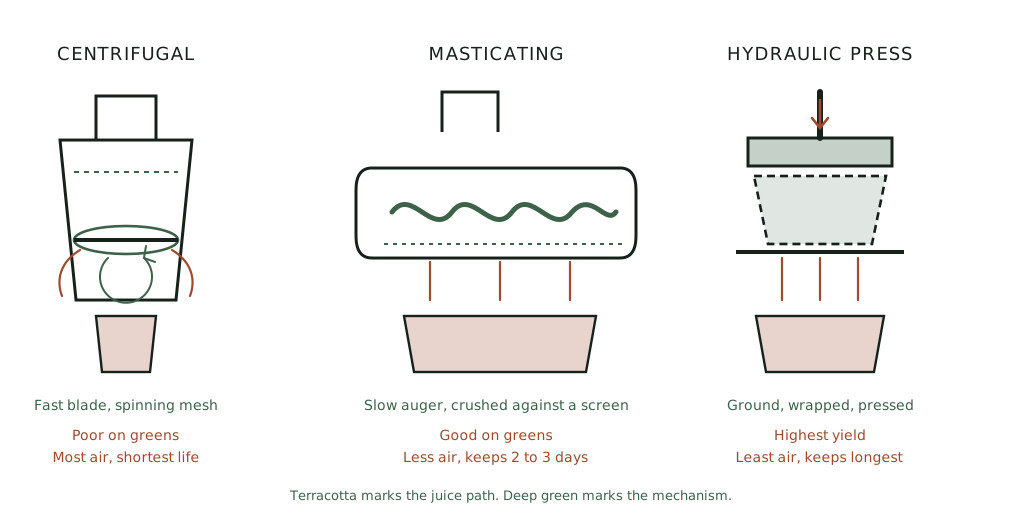
The three designs differ in ways that matter, and the right choice depends less on which is best and more on what you intend to juice.
Masticating, also sold as slow or cold press. A slow turning auger crushes produce against a screen. These handle cabbage, leafy greens, herbs, and wheatgrass properly, which centrifugal machines do not. Yields run higher across most produce, and less air is introduced, so the juice holds its colour and flavour longer.
Within this category, horizontal designs generally have fewer components and a coarser, more accessible screen than vertical ones, which is why they tend to rinse clean in a couple of minutes. If cleaning speed has put you off juicing before, this is the specific design characteristic to look for, and it is worth more than any feature on a spec sheet.
For the breakfast glass this is the correct machine, and a self-feeding horizontal cold press juicer is the pattern. Cabbage and celery both reward slow crushing.
Centrifugal. A fast blade shreds produce against a spinning mesh basket, as in a dual-speed centrifugal juicer with a 3 inch chute. These are the quickest and least expensive machines, and the wide feed chute takes whole apples with no cutting. A reasonable choice for anyone juicing mostly hard fruit and carrots.
They handle cabbage and leafy greens poorly, yields are lower, and the fine mesh basket takes the longest to clean of any component in this category.
Hydraulic press. Produce is ground, wrapped in a cloth, and pressed under high force. Norwalk is the name most associated with this at home, and these are sold direct and second hand rather than through general retailers. Highest yield and longest keeping juice available. It is a two stage process with a cloth to launder, which suits a household juicing daily at volume and very few others.
The detailed comparison guide below walks through the first two side by side, which is the decision nearly everyone is actually making.
Cleaning in two minutes
Cleaning is a matter of sequence rather than effort, and getting the sequence right is what turns juicing into something you keep doing.
Rinse before you drink, not after. This is the whole technique. Wet pulp rinses off in seconds. Pulp that has dried onto a screen needs soaking and scrubbing. Take the machine apart and rinse it the moment it stops, then sit down with the glass. The juice does not suffer from a two minute wait and the screen very much does.
Push pulp out of the mesh, not further into it. Rinse the screen from the outside in, under a running tap. This clears the mesh in one pass instead of driving pulp deeper with every stroke.
Keep the brush beside the machine. Not in a drawer. The brush that shipped with your juicer is shaped for its screen and works far better than a sponge. A brush in a drawer is a brush you will not fetch.
Let it air dry. Most components dry on a rack faster than you can towel them, and juicer parts assemble more easily dry than damp.
Done in this order the breakfast glass costs about two minutes of cleaning, which is less than a frying pan and considerably less than a roasting tin. Cooking an ordinary dinner generates more washing up than juicing does. If your experience has been otherwise, the cause is almost always the delay between finishing and rinsing rather than the machine itself.
Preparing produce
Preparation sets both your yield and how often the machine jams, and it takes less time than expected once the sequence is fixed.
Wash everything properly. Juice concentrates whatever is on the surface, and there is no heat step downstream. A firm brush under running water handles carrots and celery. Cabbage needs its outer leaves removed and a rinse.
Peeling is mostly unnecessary. Carrots, apples, celery, and cabbage go in unpeeled once well washed, and a good share of what is worth having sits close to the skin. Lemon is the exception and must be peeled, since the oils in the peel are intensely bitter and a small amount changes the whole glass. Ginger only needs peeling if it is old and dry.
Cut to suit the chute. Masticating machines want pieces of roughly a thumb's length, and cabbage cut into wedges narrow enough to feed without forcing. Centrifugal machines with wide chutes take whole apples and small carrots.
Feed order matters, and it is the easiest yield improvement available. Alternate soft and hard rather than sending everything of one type through together. For the breakfast glass that means lemon, ginger, celery, carrot, cabbage, carrot, apple, and a final carrot. The hard items push the soft ones through the screen, which raises yield and reduces clogging. Ending on something hard clears the auger, which also shortens the cleaning.
Lemon and ginger go in near the start so their flavour distributes through everything that follows.
Drink it fresh, and store it properly if you cannot
Juice begins changing as soon as it is made, mostly through contact with air, and a few habits keep it at its best.
Drink it within two hours of making it. That is the standard, and it is easier to follow than any table of windows.
If that does not fit your morning, decant immediately into six ounce glass canning jars, filled to the rim so the juice meets the lid with no air gap, capped, and refrigerated. Small jars rather than one large bottle, because a large container gets opened repeatedly and every opening replaces the headspace with fresh air. Use glass rather than plastic. The half lemon in the breakfast glass helps here too, since the acidity slows browning noticeably.
Realistic quality windows are short. Juice from a centrifugal machine is best drunk straight away and holds acceptably for around a day. Masticating juice commonly holds two to three days, which is what makes batching two mornings at once practical. Pressed juice keeps longest.
One point belongs here plainly rather than buried. Home juice is unpasteurised. For most healthy adults that is unremarkable. For anyone pregnant, elderly, very young, or immunocompromised, guidance in most jurisdictions treats unpasteurised juice as higher risk, and it is worth checking your own national authority's current position rather than any website's summary.
Getting more glass from the same produce
Yield is the number that decides your running cost, and it responds well to a few specific changes.
Produce choice. Celery, cucumber, cabbage, and watermelon give up their liquid readily. Carrot and beetroot yield well and are dense, so a small weight goes a long way. Leafy greens yield very little for their bulk, which is why the breakfast glass uses cabbage as its green. Cabbage delivers several times the juice for the same money.
Machine. A masticating juicer typically extracts meaningfully more from the same input than a centrifugal one, especially on cabbage and greens. Over a year that difference is real money, and it is the strongest practical argument for the more expensive machine.
Feed order. Covered above, and worth repeating because it costs nothing.
Pulp check. Squeeze a handful of pulp over the sink. If liquid runs out freely you are leaving juice behind, and feeding more slowly usually fixes it on a masticating machine.
Weigh your produce and measure your output once. Most people have never done this and are surprised by the result, and the number tends to change what they buy.
What juices well
Reliable. Carrot, beetroot, celery, cucumber, cabbage, fennel, apple, pear, citrus, ginger, and most hard vegetables. These are the backbone of nearly every worthwhile glass.
Belongs in a blender instead. Banana, avocado, and mango have almost no free liquid and will clog most machines. Berries yield acceptably and cost a great deal per millilitre.
Needs a little care. Peel citrus. Cut fibrous stems short so they cannot wrap the auger. Remove apple seeds, which is easy and a sensible default.
Often discarded and perfectly good. Beetroot leaves, broccoli stalks, herb stems, and carrot tops all juice well and usually go in the bin at the shop.
Juice and smoothies are different tools
These get treated as variations on one idea and they are not, which is why people sometimes buy the wrong machine.
A juicer separates and sets aside the fibre. A blender keeps everything and breaks it down. Everything else follows from that.
Juice is thin, absorbs quickly, and lets you take in a large volume of vegetables fast. It works well alongside a meal, which is exactly how the breakfast glass is used: with eggs, or with whatever the actual breakfast is, rather than as a replacement for it.
A smoothie is thick, absorbs slowly, keeps the fibre, and fills you up. It is the better tool for a meal in itself, for anything fruit based, and for ingredients with no free liquid. a Vitamix 5200 is the reference machine, and a far cheaper blender still does the job.
Many households own both and use them for different jobs, which is a sensible outcome rather than a redundancy.
Pulp is not waste
Juicing generates a good quantity of pulp and most of it is worth keeping.
Carrot and beetroot pulp is the most useful. It folds into muffins, fritters, and veggie burgers, where the moisture and colour both help, and it bulks out a bolognese or a lentil stew without changing the flavour much.
Apple pulp goes into porridge, into a crumble topping, or dries in a low oven into a chewy snack. Use it the same day, since it browns fast.
Cabbage and celery pulp is largely spent fibre and is the best candidate for the compost heap, which is a genuinely good outcome rather than a consolation. Juicing pulp breaks down quickly and is a useful green input.
Freeze what you cannot use within a few days, in portions, and label it. Carrot and beetroot pulp look very similar once frozen.
Buying produce
Produce is the running cost, and a few habits reduce it substantially without changing the glass.
Buy by season and by weight rather than by recipe. A recipe demanding six specific ingredients sends you shopping for whichever one you lack. A structure like the one above lets you build around whatever hard vegetable is good this week.
Cosmetically imperfect produce is ideal here. Bent carrots, small apples, and split cabbage juice exactly as well as perfect specimens and are often discounted precisely because they look wrong.
Buy hard produce in quantity and greens in small amounts. Carrots, cabbage, beetroot, and apples keep for weeks in a cool place, which is another reason the breakfast glass is economical. Leafy greens decline within days and are the item most often thrown away half used.
Where the machine lives
This sounds like a footnote and predicts more than it should.
A juicer stored in a cupboard gets used until the novelty fades. A juicer left assembled on the counter near the sink gets used indefinitely, because the barrier is one decision rather than five.
Sink proximity matters more than people expect, since every stage involves water: washing produce before, rinsing components after. A machine on the far side of the kitchen from the tap adds a carrying step to both ends of the routine.
If counter space genuinely does not allow it, that is useful information rather than an obstacle to push through. It points toward a smaller machine or a citrus press, and choosing the appliance that fits your kitchen beats owning a better one you never take out.
Worth knowing
Two things, stated once.
Juice is a food. Specific detox, cleanse, or cure claims attached to particular juices generally run ahead of what the research supports, and nothing on this site is medical advice. Anyone juicing for a specific health reason should raise it with a clinician.
And juice complements a diet rather than replacing parts of it. Used alongside real meals, which is how the breakfast glass is intended, it adds vegetables you would not otherwise eat. That is a straightforwardly good thing and it is the entire case for the practice.
Variations on the breakfast glass
Once the structure is familiar, the glass adapts to whatever the season and the shop are offering, and it stays recognisably the same drink.
Swap the green. Cabbage is the default for yield and keeping quality. Broccoli stalks work beautifully and are usually free, since most people discard them. Fennel brings an aniseed note that suits the lemon. Kale and spinach both work in a masticating machine and give less volume for the money.
Swap the body. Beetroot in place of one or two of the carrots gives a deeper colour and a rounder sweetness. Half a raw sweet potato is unexpected and good. Keep carrot as at least part of the base, since it carries the other flavours well.
Swap the acid. Lime instead of lemon shifts the whole glass toward something brighter and slightly tropical. A small green apple can do part of this job, though lemon does it better and adds less sugar.
Adjust the heat. Turmeric root alongside the ginger deepens the colour and the flavour. A very small piece of fresh chilli is worth trying once, and a little goes a long way.
Winter version. Carrot, beetroot, cabbage, ginger, lemon, and a pear instead of the apple. Everything in that list stores for weeks, which makes it a practical glass in months when fresh greens are expensive and poor.
Summer version. Cucumber replacing the cabbage for volume, celery, one carrot, mint, lime. Lighter and more refreshing, and it wants drinking immediately rather than storing.
The rule holds through every variation. Vegetables carry the glass, fruit seasons it, acid brightens it, and something warm finishes it. Keep those four roles filled and almost any substitution works.
RUN THE NUMBERS
Illustrative figures only, drawn from typical ranges rather than your local prices, and not a promise about your results.
| The breakfast glass | |
|---|---|
| Carrots | 4 medium |
| Green cabbage | One wedge, roughly a quarter of a small head |
| Celery | 3 sticks |
| Green apple | 1 |
| Ginger | A thumb |
| Lemon | Half, peeled |
| Prep and juicing | About 4 minutes |
| Cleaning, rinsed immediately | About 2 minutes |
| Keeps, masticating machine | 2 to 3 days, container filled to the top |
| Centrifugal | Masticating | Hydraulic press | |
|---|---|---|---|
| Entry cost | Lowest | Middle to high | Highest |
| Cabbage and greens | Poor | Good | Excellent |
| Hard produce | Good | Good | Excellent |
| Yield | Lowest | Higher | Highest |
| Keeps for | Around a day | 2 to 3 days | Longest |
| Cleaning | Longest | Two minutes if rinsed at once | Longest, plus a cloth |
WHAT GOES WRONG
Juice that tastes mostly of sugar. Too much fruit in the base. Rebuild on celery or cucumber and move the apple to a supporting role.
Very little juice from leafy greens. Normal, and much worse on a centrifugal machine. Use cabbage as your green instead and the yield problem disappears.
Cleaning that takes ten minutes. Dried pulp. Rinse before you drink rather than after, and push pulp out of the screen from the outside.
Juice that browns and separates within the hour. Air. Fill the container to the top, use glass, refrigerate at once, and include the lemon.
A clogged auger. Long fibrous stems fed in whole. Cut them short and alternate soft with hard.
DO THIS NOW
- Make the breakfast glass exactly as listed: four carrots, a cabbage wedge, three celery sticks, one green apple, ginger, half a peeled lemon.
- Feed in this order: lemon, ginger, celery, carrot, cabbage, carrot, apple, carrot.
- Rinse every component before you sit down with the glass, pushing pulp out of the screen from the outside.
- Drink it with breakfast rather than instead of it.
Where to start
All ten guides are live. Work through them in the order the glass is built.
Before anything else, make sure you want a juicer at all: juice or smoothie covers the one structural difference between the two machines and the test that settles it. Then prove the habit for the price of a straining bag: cold pressing without a press makes genuinely good juice with a blender you already own.
Composition next, because it decides whether you keep drinking it: green juice built on vegetables sets out the five roles and the seasonal versions.
Then the machine: masticating or centrifugal compares the two on greens, yield, shelf life, and cleaning, which are the four things that genuinely differ. If citrus is most of what you drink, citrus juicing explains why a press beats any machine on this page.
Then the routine that decides whether any machine survives its first month: cleaning a juicer in two minutes.
Then how long it keeps and what protects it: juice storage and oxidation covers the two hour rule and the small jar fallback. And the other half of every batch: what to do with juice pulp.
Two ingredients get their own pages because they are asked about most. Celery juice separates what celery is actually good at from the claims that made it famous. Wheatgrass at home covers growing a tray for almost nothing and pressing it without ruining a machine.
The sprouting and microgreens hub is the natural companion. Wheatgrass sits directly between the two, grown like a microgreen and consumed like a juice.
Guides in this hub
- Celery Juice, Examined ProperlyWhat celery juice is good for, what the popular claims actually rest on, and how to make it taste like something you want to drink.
- Citrus Juicing, and the Machine You Do Not NeedCitrus is the one thing a full juicer handles worse than a tool costing a fraction as much. Here is which press to buy for which job.
- Cold Pressing Without a PressA blender and a straining bag make genuinely good juice for almost nothing, and it is the honest way to find out whether you want a machine at all.
- Green Juice Built on VegetablesA five part structure that lets you build a good glass from whatever is in the shop, without a recipe and without a fruit base.
- What to Do with Juice PulpWhich pulp is worth keeping, what to make with it, and which kinds are honestly better on the compost heap.
- Juice Storage and OxidationHow long fresh juice actually keeps, what changes while it sits, and the four habits that stretch the window.
- Juice or Smoothie: Which One You Actually WantThe two drinks solve different problems, and a good share of people shopping for a juicer would be better served by a blender.
- Cleaning a Juicer in Two MinutesThe sequence that turns a ten minute chore into a two minute one, on any machine, without changing anything you own.
- Masticating or Centrifugal: Which Juicer to BuyThe two machines most people choose between, compared on the four things that actually differ: greens, yield, shelf life, and cleaning.
- Wheatgrass at HomeGrowing your own wheatgrass on a tray, juicing it without ruining a machine, and what it actually tastes like.