Guide
Juice or Smoothie: Which One You Actually Want
The two drinks solve different problems, and a good share of people shopping for a juicer would be better served by a blender.
As an Amazon Associate this site earns from qualifying purchases. Links to products may be affiliate links. This costs you nothing extra and does not change what gets recommended. Nothing here is medical advice.
A meaningful share of people shopping for a juicer want a blender, and a smaller share of people who own a blender are frustrated because it will not do what a juicer does. Both mistakes are expensive and both are avoidable in about a minute of thinking.
The two machines are not competitors on a quality scale. They perform opposite operations, and the right one follows from what you want the drink to do.
The one structural difference
A juicer separates the liquid from the insoluble fibre and discards the fibre. A blender keeps everything and breaks it down.
That is the whole distinction, and the juicing hub opens on the same point. Every practical difference below follows from it, and nothing else about the two categories matters nearly as much.
Once you hold that in mind, most of the marketing in both categories becomes easy to read. Machines that claim to do both are usually blenders with a filter, and a filter is not the same operation as a press.
What follows from it
Texture. Juice is thin and drinkable in seconds. A smoothie is thick and takes minutes.
Fullness. Fibre slows digestion and contributes to satiety. A smoothie can be a meal. A juice cannot, and treating one as a meal replacement is how people end up hungry by ten and blaming the juice.
Volume of vegetables. This is the juicer's real advantage. Four carrots, a wedge of cabbage, and three sticks of celery is more than most people will sit down and eat. In a glass it goes down in ninety seconds. A blender cannot compress volume this way, because everything you put in stays in the glass.
Sugar absorption. Without fibre, sugars reach you faster. This matters for fruit and matters much less for the vegetable-led structure this site uses. It is the main reason a fruit-heavy juice deserves more caution than a fruit-heavy smoothie.
Ingredients that work. Banana, avocado, mango, and anything else without free liquid cannot be juiced in any meaningful sense. Frozen fruit, nuts, oats, yoghurt, and protein powder all belong in a blender and in none of them in a juicer.
Waste. A juicer produces pulp. A blender produces none. The pulp guide covers what to do with it, and it is a genuine consideration rather than a footnote.
Cost and cleaning. A blender is cheaper, faster to clean, and has fewer parts. A juicer costs more and needs a screen brushed immediately. This alone decides it for a fair number of households.
The test
Answer one question: what do you want the drink to do?
If the answer involves being full, being breakfast, or containing fruit, you want a blender. It is cheaper, easier, faster to clean, and correct for the job.
If the answer is getting a large volume of vegetables into yourself in a form you will actually drink, you want a juicer, and a self-feeding horizontal cold press juicer or the cheaper a dual-speed centrifugal juicer with a 3 inch chute both qualify.
If the answer is both, on different days, own both. This is extremely common and is not indecision. They do different jobs and most households that have both use the blender more often.
If the answer is a specific health outcome, neither machine is the deciding factor and the question belongs with a clinician rather than an appliance review.
Where each one genuinely wins
Juice wins on vegetable volume, speed of drinking, glasses that sit alongside a meal, and anything built on celery, cucumber, cabbage, carrot, or beetroot. It also wins on wheatgrass and hard greens, which a blender turns into unpleasant fibrous sludge rather than a drink.
A blender wins on breakfast, anything containing frozen fruit, anything containing fat or protein, green smoothies with spinach and banana, soups, nut milks, and cost. It also wins decisively on cleaning, which for many people is the whole argument.
Neither is better. A juice and a smoothie made from the same produce are different foods, and preferring one is a matter of what you need that morning.
The hybrid options, briefly
Blender plus a nut milk bag. Blend produce with a little water, then strain through a fine mesh bag, squeezing by hand. This produces genuinely good juice at very low equipment cost, and it is the cheapest way to find out whether you want a juicer at all. The drawbacks are real: it is messy, it takes longer, and the added water dilutes the result.
Machines that claim to do both. Usually blenders with a strainer attachment. They tend to do one job well and the other adequately. If you already know you want both, two separate machines generally beat one compromise.
Masticating juicers with a blank screen. Some slow juicers ship with a solid screen that turns them into a coarse purée maker for sorbets and nut butters. This is a genuine bonus feature rather than a second machine, and worth knowing if you are already buying one.
What to do with the pulp question
The single objection to juicing that carries real weight is the fibre going to the bin, and it has a straightforward answer.
You do not have to choose one drink for your whole diet. A vegetable juice alongside a breakfast that includes real food covers both, which is exactly how the standard glass on this site is intended to be used.
The pulp itself is worth keeping for some produce, particularly carrot and beetroot, and the pulp guide sorts what is worth rescuing from what belongs on the compost heap.
And a blender in the same kitchen means the fibre question resolves itself on the days it matters.
Running both from one shop
Households that own both machines often buy produce twice, which is unnecessary. A single shop covers both drinks if you buy with the split in mind.
Buy hard produce for the juicer. Carrots, celery, cucumber, beetroot, cabbage, apples, lemons, ginger. All of these keep for one to three weeks in a cool place, which means a single weekly shop covers every juice you will make.
Buy soft and frozen produce for the blender. Frozen berries, frozen mango, bananas at various stages of ripeness, spinach, yoghurt, oats, nut butter. Frozen fruit is the key item, since it removes the race against spoilage entirely and gives a smoothie the cold thickness that fresh fruit does not.
Let the overlap work for you. Ginger, lemon, and spinach belong in both. Buy them once.
Use the blender to rescue. Produce that has gone slightly soft is fine in a smoothie, and bananas that have gone brown are better in one than they were fresh. This is where the week's shopping mistakes go to be useful rather than binned.
Use the juicer for the bulk vegetables. The heavy, cheap, long keeping items that nobody wants to eat in quantity.
A practical division: the juicer handles your vegetable intake, the blender handles breakfast. Once the shop is organised that way the two machines stop competing for the same produce and start covering different parts of the week.
One more efficiency worth knowing. Juice pulp from carrot or beetroot can go into a smoothie, which recovers some of the fibre without any extra effort. It thickens the drink and the flavour disappears under fruit.
RUN THE NUMBERS
Illustrative comparison only, and not a promise about prices or results.
| Juicer | Blender | |
|---|---|---|
| Keeps fibre | No | Yes |
| Fills you up | No | Yes |
| Vegetable volume per glass | High | Limited |
| Banana, avocado, oats, nuts | No | Yes |
| Wheatgrass and hard greens | Yes, masticating only | No |
| Waste produced | Pulp | None |
| Typical entry cost | Higher | Lower |
| Cleaning | 2 minutes if rinsed at once | Under a minute |
| Parts to wash | 4 to 6 | 2 |
The honest summary: if you can only own one and you are not sure, own the blender. It is cheaper, more versatile across meals, and easier to live with. a Vitamix 5200 is the machine most people who take this seriously end up with, and the smaller Explorian E310 does the same job in a smaller jug. Buy the juicer when you know specifically that vegetable volume is what you are after.
Counter space decides more than you think
Neither machine gets used if it lives in a cupboard, and most kitchens do not have room for two appliances standing out permanently.
Be honest about which one earns the counter. For most households that is the blender, because it gets used more often and across more meals. The juicer then needs a home that is genuinely easy to reach rather than the back of a low cupboard behind the slow cooker.
If only one can stay out, that is a real argument for owning only one. An appliance retrieved from storage gets used for a fortnight and then stops, and a juicer in a cupboard produces nothing at all.
Two arrangements work. Rotate seasonally, keeping the juicer out through the months when hard vegetables are cheap and the blender out when berries are. Or accept a compact machine for whichever role matters less, since a smaller footprint that stays visible beats a better model in a box.
WHAT GOES WRONG
A juicer bought for smoothies. It will not make them. Banana and avocado clog it.
A blender bought for green juice. It makes a thick green drink, which is a different thing, and many people find it unpleasant compared to juice.
Treating juice as a meal. It is not one. Hunger by mid morning follows reliably.
A hybrid machine that disappoints at both. Usually a blender with a filter. Two machines beat one compromise if you genuinely want both drinks.
Buying the expensive option first. Try the nut milk bag method for a week. It costs almost nothing and answers the question honestly.
DO THIS NOW
- Write down what you want the drink to do. Full, or breakfast, or fruit means blender.
- If you are unsure, blend produce with a little water and strain it through a nut milk bag once. That is juice, made for nothing.
- If vegetable volume is the goal, price a juicer. If it is anything else, price a blender.
- If you already own a blender, do not replace it. Add the other machine when you know why.
Next
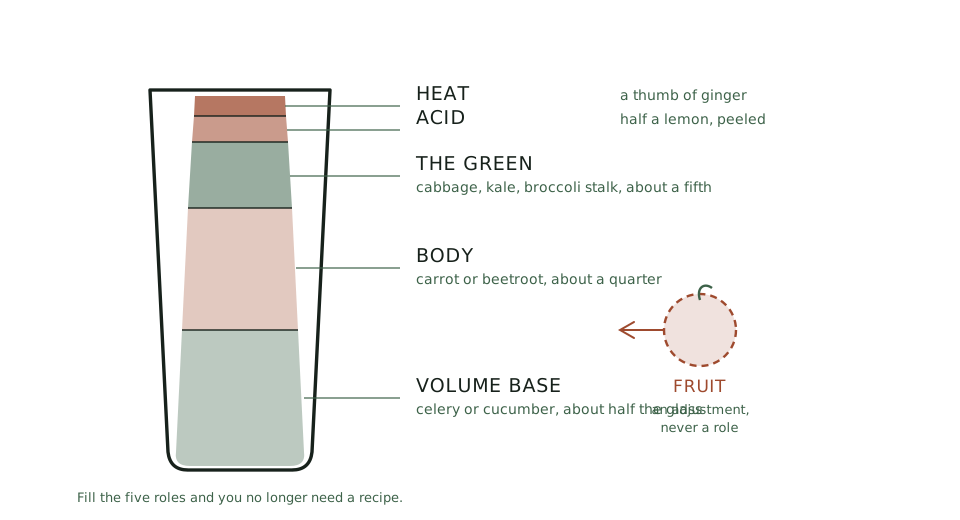
For the vegetable-led glass a juicer is for, and the five roles that make it work without a recipe, see green juice built on vegetables.
The fibre a juicer sets aside does not have to be wasted. What to do with juice pulp covers which kinds earn a place in the kitchen.