Guide
Cooking With Powders
Powders do one thing fresh ingredients cannot: deliver the flavour of a vegetable without its water. That is worth more in a kitchen than any smoothie.
As an Amazon Associate this site earns from qualifying purchases. Links to products may be affiliate links. This costs you nothing extra and does not change what gets recommended. Nothing here is medical advice.
Most writing about food powders assumes they go into a drink. That is the least interesting thing they do.
The genuinely useful property is that a powder delivers the flavour and colour of a vegetable without its water. There is a long list of things in a kitchen where extra moisture is a problem and extra flavour is welcome, and that list is where powders earn a permanent place.
The powders hub covers making them. This page covers using them.
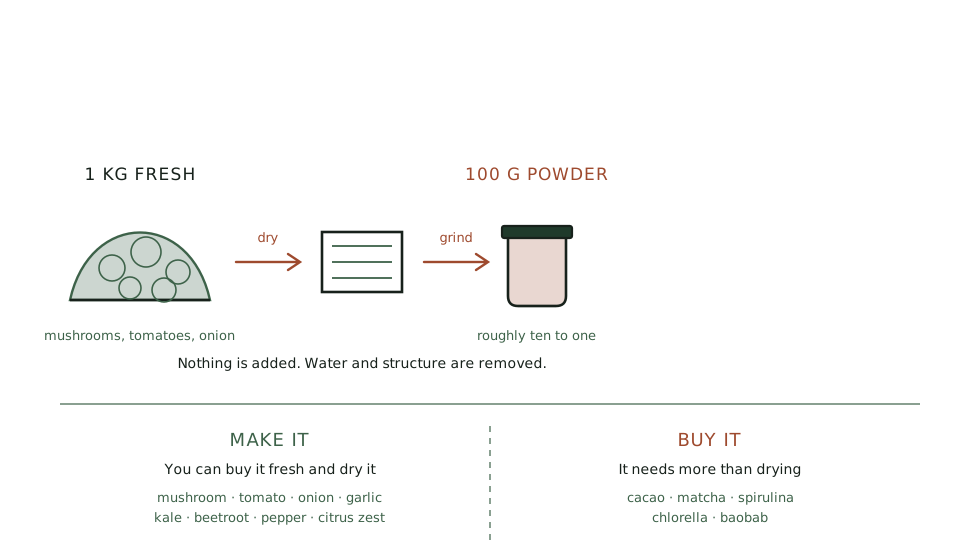
The rule about heat
Two categories, opposite treatment, and getting this wrong is the most common mistake.
Savoury powders go in early. Mushroom, tomato, onion, garlic, celery, and vegetable powders want heat and liquid to bloom. Their flavour compounds are relatively stable and they need time to disperse and integrate. Add them at the start of a sauce, stew, or braise.
Green, fruit, and aromatic powders go in cold or at the end. Green powders, berry powders such as an acai powder, matcha, and citrus zest all lose colour and aroma to heat. Add them off the heat, or into something cold.
The test is what you are after. If it is savoury depth, heat helps. If it is colour, freshness, or aroma, heat destroys.
an organic unsweetened cacao powder and other cacao sits between the two and tolerates heat well, which is why it is used in baking rather than stirred in at the end.
Make a paste first
The single most useful technique on this page, and it takes ten seconds.
Powder tipped dry into a hot pot or a full glass clumps immediately, and once clumped it will not disperse no matter how much you stir. The outside of each lump hydrates and forms a barrier.
Instead, put the powder in a small bowl, add a spoonful of the liquid you are cooking with, and work it to a smooth paste with the back of a spoon. Then stir the paste into the pot.
This works for every powder in every application. Tomato powder into paste, mushroom powder into stock, green powder into a little juice before adding it to the glass, matcha into a little water before adding milk.
For dry applications like rubs and doughs, mix the powder thoroughly with the other dry ingredients before any liquid arrives, which achieves the same thing by a different route.
In doughs and batters
This is where powders do something a fresh ingredient genuinely cannot.
Adding puréed vegetable to a dough changes its hydration and usually ruins it. Adding the powder changes the flavour and the colour and leaves the hydration alone.
Pasta dough. Tomato, beetroot, spinach, or herb powder, at roughly one to two percent of the flour weight. Colour and flavour with no adjustment to the egg or water.
Bread. Tomato and herb powders in the dough rather than only on top. Beetroot for colour. A little onion powder in a savoury loaf.
Pancakes and waffles. Beetroot or berry powder for colour, which is particularly effective for children.
Dumpling and ravioli wrappers. Spinach or beetroot for visual contrast.
Pastry. Cheese or herb powders in a savoury shortcrust.
Start small. One to two percent of the flour weight is visible and tastes mild. Five percent is assertive and can affect gluten development.
In rubs and dry seasonings
Dry blends need dry ingredients, which makes this the most natural home for powders.
A basic rub. Garlic powder, onion powder, smoked paprika, black pepper, salt, and a little sugar. Home made garlic and onion powder make a noticeable difference here.
Mushroom salt. Mushroom powder to flaky salt at about one to four. Excellent on eggs, chips, popcorn, and roasted vegetables.
Celery salt. Celery powder to salt at about one to four. Expensive to buy and trivial to make.
Tomato and herb. For roasted vegetables and focaccia.
Citrus zest in a rub is underused and works particularly well with fish and chicken.
Grind rubs slightly coarser than a drink powder. A little texture is desirable and the coarse fraction from your sieve is perfect for this.
As a thickener that adds flavour
A starch thickens and contributes nothing. A vegetable powder thickens slightly and contributes flavour, which is a better trade in most savoury cooking.
A spoonful of mushroom or tomato powder in a sauce adds body while deepening it. The effect is modest compared to a starch, so this works alongside rather than instead of a roux or a slurry where real thickening is needed.
It is particularly good in gravy, where you want both, and in a pan sauce where you are deglazing and reducing anyway.
Powdered vegetables also help a soup that tastes thin without adding volume. This is the fix for a stock that lacks depth.
In fats
Powders disperse well in fat and stay suspended, which opens up two useful preparations.
Compound butters. Soften butter, work in a powder and some salt, roll in parchment, and chill. Mushroom butter on steak, garlic and herb butter on bread, tomato butter on pasta.
Infused oils. Warm oil gently with a powder and let it settle, or leave it suspended. Chilli and garlic oils work particularly well.
In a dressing. Powder in the oil phase before emulsifying, rather than added to the finished dressing where it will sit as grit.
One caution: fat plus powder plus time is the combination where rancidity appears. Refrigerate compound butters and use infused oils within a few weeks.
In coatings and crusts
Powder mixed into flour or breadcrumb for dredging adds colour and flavour before anything hits the pan.
Tomato and paprika powders give a good colour to fried chicken and fish. Mushroom powder in a breadcrumb crust adds savoury depth. Herb powders distribute more evenly than dried herb leaves.
Keep the proportion low, around five percent of the flour, since powders burn faster than flour does at frying temperatures.
Portioning, honestly
Powders are concentrated and easy to overdo, and the failure is usually in one direction.
A teaspoon is a serving for most savoury powders in a dish for two to four people.
Start below what a recipe suggests and taste. You can add and you cannot remove.
Green and chilli powders are the most assertive. Half a teaspoon is plenty to begin with.
Tomato powder as paste is roughly one part powder to two parts water by volume, adjusted to the thickness you want.
In doughs, work by percentage of flour weight rather than by spoons, since it scales predictably.
Write down what worked. A quantity you liked and cannot remember is the most common reason a good result is not repeated.
Building a shortlist that gets used
A cupboard of fifteen powders gets ignored. Four or five get used, and choosing which is worth doing deliberately.
One savoury depth powder. Mushroom. It goes into more dishes than anything else in this hub.
One colour and body powder. Tomato, which doubles as paste.
Two aromatics. Garlic and onion, both far better home made.
One bright note. Citrus zest, which is free and lifts both savoury and sweet applications.
That is five jars covering the large majority of what powders are good for. Everything else is a specialist addition.
Keep them together, near where you cook, in identical jars so the set reads as one thing rather than as scattered oddments. This sounds cosmetic and it changes how often the set gets opened.
Add a sixth only when you notice yourself wanting it repeatedly, rather than because it looked interesting. A powder bought or made out of curiosity and used twice is the most common way this cupboard fills with things nobody reaches for.
The powders hub makes the same argument about blends: five ingredients or fewer, chosen deliberately, beats twenty chosen for the label.
RUN THE NUMBERS
Illustrative starting quantities. Adjust to taste and to the strength of your powder.
| Application | Quantity | Add when |
|---|---|---|
| Sauce or stew, 4 portions | 1 to 2 tsp savoury powder | At the start |
| Gravy | 1 tsp mushroom powder | With the liquid |
| Tomato paste substitute | 1 part powder, 2 parts water | As needed |
| Pasta or bread dough | 1 to 2 percent of flour weight | With the dry ingredients |
| Dry rub | 1 part powder to 4 parts salt | Mixed dry |
| Smoothie or juice | 1 tsp green powder | At the end, cold |
| Coating flour | About 5 percent | Mixed dry |
| Compound butter | 1 tbsp per 100 g butter | Worked in cold |
The general principle: savoury powders early and generously, aromatic powders late and sparingly.
Powders in drinks, briefly
Since this is where most people start, it is worth covering properly even though it is not where powders are most useful.
Always make a paste first. A spoonful of powder with a little of the liquid, worked smooth, then the rest added. Powder tipped into a full glass clumps and stays clumped.
Cold or room temperature liquid for green, fruit, and aromatic powders. Heat costs colour and aroma.
A blender beats a spoon for anything you want fully dispersed, and a small milk frother is an excellent cheap alternative.
Expect settling. Most vegetable powders suspend rather than dissolve, so a drink left standing will separate. Stir and drink promptly.
Fat helps. A powder in a smoothie containing yoghurt, milk, or nut butter disperses better and tastes rounder than the same powder in water.
Acid helps too. A squeeze of lemon or a sour fruit cuts the grassiness of green powders directly.
Start at a teaspoon. Powders are assertive and a heavy hand makes a drink nobody finishes.
WHAT GOES WRONG
Clumps that will not disperse. Powder added dry to liquid. Make a paste first, every time.
Green powder turned brown in a cooked dish. Heat. It should have gone in at the end or not at all.
A dish that tastes overwhelmingly of one thing. Too much powder. Start at a teaspoon.
Gritty dressing. Powder added to the finished emulsion rather than to the oil phase.
Burnt coating. Too high a proportion of powder in the dredging flour.
A dough that behaved oddly. More than about five percent powder by flour weight starts to interfere with gluten.
A result you cannot reproduce. Nothing written down.
DO THIS NOW
- Make a paste with a spoonful of liquid before adding any powder to any dish. This one habit prevents most problems.
- Put a teaspoon of mushroom powder into the next gravy or stew, at the start rather than the end.
- Make mushroom salt at one part powder to four parts flaky salt and keep it by the stove.
- Add one percent tomato or beetroot powder by flour weight to your next batch of pasta or bread dough.
Next
For the four vegetable powders that do most of the work in the applications above, see tomato, onion, garlic.
The single most useful jar, and the one that disappears invisibly into anything savoury, is covered in mushroom powder, the most useful jar.