Guide
Mushroom Powder, the Most Useful Jar
A spoonful adds savoury depth to almost anything and dissolves completely. Made from reduced mushrooms it costs close to nothing.
As an Amazon Associate this site earns from qualifying purchases. Links to products may be affiliate links. This costs you nothing extra and does not change what gets recommended. Nothing here is medical advice.
If you make one powder, make this one.
Mushroom powder adds savoury depth to almost anything cooked in liquid, it dissolves completely so nobody detects it as an ingredient, and it is made from mushrooms at their cheapest, which is when they have started to open and been reduced.
It is also the powder with the widest gap between what it costs to make and what it costs to buy, since dried mushroom is priced as a delicacy in most shops.
Why it works
Mushrooms are unusually rich in glutamates and related compounds, which the palate reads as savoury depth rather than as a distinct mushroom flavour.
Drying concentrates those compounds by removing water, and in some varieties develops additional ones that were not detectable in the fresh mushroom. Grinding then makes the concentrate disperse completely, so it contributes flavour without contributing texture.
That combination is what makes it invisible in food. A spoonful in a gravy makes the gravy taste more like gravy. Nobody says it tastes of mushroom.
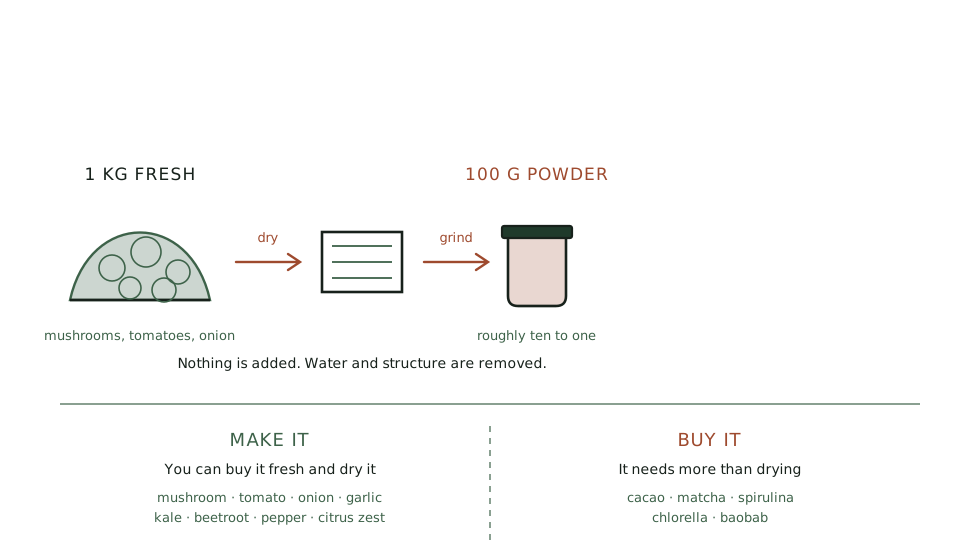
The powders hub explains the general principle: nothing is added, water and structure are removed.
Which mushrooms
Chestnut and field mushrooms. Cheap, widely available, and they make excellent everyday powder. This is what most batches should be.
Shiitake. The standout. Dried shiitake has a depth that fresh does not, and shiitake powder is noticeably more intense than the common varieties. Worth including even as a small proportion of a blend.
Porcini and other wild mushrooms. Exceptional and expensive. If you have access to them, a small quantity blended with common mushrooms lifts the whole jar.
Oyster mushrooms. Dry well and rehydrate to a slightly odd texture, which makes them better as powder than as slices.
Portobello. Large, cheap, and they dry to a very dark intense powder.
A blend beats any single variety. Two or three types produce more complexity than one, in the same way that a mixed stock beats a single ingredient one.
Do not use anything foraged unless you are certain of the identification. Drying and grinding do not make an inedible mushroom edible, and identification is a matter for expertise rather than a website.
Buying at the right moment
This is where the economics live.
Mushrooms are reduced as soon as the caps begin to open and the gills darken. At that stage they are past their best for a fresh dish and ideal for drying, because the flavour has developed further and the texture you would have been protecting is about to be destroyed anyway.
A large reduced tray costs a fraction of the same weight bought fresh and firm, and it makes better powder.
Look for reduced trays late in the day, and buy more than you think, since the reduction from fresh to powder is around ten to one.
Do not use anything slimy, smelling sour, or showing mould. Drying preserves what is present rather than removing it.
Drying them
Do not wash. Mushrooms are absorbent and washing adds water you are about to spend hours removing. Brush off soil with a dry brush or wipe with a dry cloth. If something genuinely needs a rinse, do it fast and pat dry at once.
Slice five millimetres. Thicker than most vegetables, because mushrooms shrink dramatically and thin slices disintegrate into fragments.
Include the stems. They dry perfectly well and are frequently tougher than the caps, which matters not at all once ground. Discarding them wastes a third of the mushroom.
Fifty to fifty five degrees Celsius, six to ten hours.
Dry past brittle. For powder they must snap cleanly. Mushrooms feel dry long before they are dry enough to grind, and this is the single most common reason a batch turns to paste rather than powder.
Test a cooled piece by bending it. If it flexes at all, it needs longer.
Grinding
Cool completely before grinding. Warm mushroom releases residual moisture into the powder and causes clumping.
Grind in short bursts with the bowl no more than half full, shaking between. a small electric blade grinder handles household quantities, and the grinding guide covers the technique in full.
Sieve once. Mushroom grinds unevenly because the stems are more fibrous than the caps, and there will be a coarse fraction. Return it to the grinder or keep it separately as mushroom flakes, which are good in their own right.
Wait thirty seconds before opening the lid. Mushroom dust is fine and gets everywhere.
Expect roughly a hundred grams of powder from a kilogram of fresh mushrooms.
Using it
Anything cooked in liquid. Gravy, stock, stew, braise, soup, ragu, curry, risotto. A teaspoon per portion is a reasonable starting point.
In mince. Mixed into burgers, meatballs, or a bolognese, it adds depth and a little moisture retention. This is one of the best uses.
In rubs. Combined with salt, pepper, and garlic powder for meat and roasted vegetables.
As a seasoning at the table. Mushroom salt, made by blending powder with flaky salt at about one to four, is genuinely excellent on eggs, chips, and popcorn.
In risotto and pasta. Stirred into the cooking liquid rather than sprinkled on top.
In a vegetarian or vegan kitchen it does much of the work that meat stock would otherwise do, which is the strongest single argument for keeping a jar.
Add it early. Unlike green powders, mushroom powder wants heat and liquid to bloom. Put it in at the start rather than at the end.
Make a paste first if you are adding it to a large volume. A spoonful mixed with a little liquid disperses far better than powder tipped into a full pot.
Storage
Small jars. Airtight. Dark and cool.
Mushroom powder holds its flavour better than green or aromatic powders, and two to three months at best quality is realistic, with usable flavour for considerably longer.
Keep the bulk as dried slices and grind small batches. Slices keep for a year or more; powder does not, because grinding multiplies the surface area exposed to air and humidity.
A desiccant sachet in the jar prevents the clumping that mushroom powder is particularly prone to.
Label it. Mushroom powder and several other dark powders are indistinguishable at four months.
Mushroom salt and other blends
Once you have a jar of powder, blending it is where it becomes a thing you reach for daily.
Mushroom salt. One part powder to four parts flaky salt, mixed. Genuinely excellent on eggs, chips, popcorn, roast potatoes, and grilled vegetables. This is the blend most likely to leave the cupboard and live next to the stove.
Savoury seasoning. Mushroom, garlic, onion, and a little dried thyme in roughly four, one, one, and a pinch. This is the house jar described on the powders hub and it goes into anything savoury.
Umami rub. Mushroom powder, smoked paprika, black pepper, garlic, and brown sugar. For meat and for roasted cauliflower.
Instant stock base. Mushroom powder, dried onion, dried celery, and a little dried carrot. A spoonful in hot water is a genuine stock rather than an approximation.
Furikake style. Mushroom powder with sesame seeds, dried seaweed, and salt, for rice and eggs.
Keep blends small and make them fresh. A blend ages at the pace of its most fragile component, and the aromatics go first. Writing the ratio on the jar means a blend you liked is reproducible.
RUN THE NUMBERS
Illustrative figures. Yields vary by variety and drying.
| Detail | |
|---|---|
| Fresh mushrooms | 1 kg, ideally reduced |
| Preparation | Brush clean, slice 5 mm, keep stems |
| Temperature | 52 C |
| Drying time | 6 to 10 hours |
| Dryness required | Snaps cleanly |
| Yield | Roughly 100 g powder |
| Sieving | Once, keep the coarse fraction as flakes |
| Serving | About 1 teaspoon per portion |
| Keeps | 2 to 3 months at best quality |
A kilogram of reduced mushrooms produces a jar that will season perhaps forty meals. Against the price of bought dried mushroom, this is the largest saving anywhere in this hub.
Buying dried rather than drying your own
Not everyone has a dehydrator, and buying dried mushrooms to grind is a legitimate route worth pricing honestly.
Dried mushrooms sold for cooking are already at the brittleness required, or close to it, and they grind straight away with no drying step. For anyone without a machine this makes mushroom powder immediately available.
The economics are worse and still reasonable. Dried mushroom is priced as a delicacy, particularly porcini, and grinding it yourself is considerably cheaper than buying the powder, which carries a further premium for the processing.
Two practical notes. Check the dryness before grinding, since some packaged dried mushrooms retain enough flexibility to smear rather than shatter. An hour in a very low oven fixes this. And dried mushrooms sold in Asian supermarkets, particularly shiitake, are frequently much better value than the same product in a supermarket spice aisle.
Blending bought dried porcini into home dried common mushrooms is a good compromise. A small quantity of the expensive variety lifts a large jar of the cheap one.
WHAT GOES WRONG
A paste rather than a powder. Not dried past brittle. The most common failure by a wide margin.
Clumping in the jar. Ground while warm, or stored without a desiccant in a humid kitchen.
Gritty texture in a sauce. Not sieved, or the stems left a coarse fraction that went into the jar.
Waterlogged, slow drying. Mushrooms washed rather than brushed.
Weak flavour. Common varieties only, and dried at too high a temperature. Add some shiitake and keep the temperature at 52.
Powder that took over a dish. Too much. It is more concentrated than it looks. Start at a teaspoon.
Dust everywhere. Lid opened too soon after grinding.
DO THIS NOW
- Buy a large tray of reduced mushrooms, ideally including some shiitake.
- Brush them clean rather than washing, slice at five millimetres, and keep the stems.
- Dry at 52 C until a cooled piece snaps rather than bends, which is longer than you expect.
- Grind in short bursts, sieve once, and stir a teaspoon into the next thing you cook with liquid.
Next
The three habits that decide powder quality apply to every jar in this hub. Grinding and sieving covers dryness, burst technique, and why sieving matters.
Green powders run on the opposite temperature rule and are the other jar worth making. Green powder that is actually green covers why 38 degrees rather than 52.