Guide
Grinding and Sieving, Where Powder Quality Comes From
Dry it past brittle, grind in short bursts, sieve once. Three habits separate a good home powder from a gritty one.
As an Amazon Associate this site earns from qualifying purchases. Links to products may be affiliate links. This costs you nothing extra and does not change what gets recommended. Nothing here is medical advice.
The difference between a home made powder that looks and behaves like a bought one and a gritty, clumping disappointment comes down to three habits. None of them requires expensive equipment.
Most people get the drying right and then rush the grinding, which is exactly the wrong way round. The powders hub covers what to make and what to buy; this page covers turning dried food into something you would actually put in a jar.
Dry it past brittle
This is the first habit and the one that decides whether the rest is even possible.
Food destined for powder must be drier than food destined for storage as slices. It has to snap cleanly rather than bend. Anything with residual flexibility will smear rather than shatter, gum the blades, and produce a damp paste that never becomes powder.
The test is simple. Take a cooled piece and try to break it. If it bends at all, it goes back in the machine for another hour.
This matters most for things people assume are already dry. Tomatoes stay leathery by design and need considerably longer for powder than for eating. Mushrooms feel dry long before they are brittle enough. Fruit is often the worst offender because sugar keeps it pliable.
Cool before testing, always. Warm food feels more flexible than it is, which means a batch tested hot gets put away underdried.
A batch that will not grind is almost never a grinder problem.
The grinder
A blade grinder sold for coffee or spices is the correct tool for household quantities. a small electric blade grinder handles small batches and costs very little.
A detachable bowl matters more than power. Cleaning between garlic and berry powder is otherwise close to impossible, and a grinder that traps residue in a fixed housing will flavour everything you make in it afterwards. a larger grinder with a detachable bowl has a removable stainless bowl and a larger capacity, which is the version worth having if you make powders regularly.
A high powered blender such as a Vitamix 5200 works well for large volumes and badly for small ones, since the blades cannot reach a thin layer at the bottom of a big jug. Half a jug minimum.
A pestle and mortar works, is slow, and gives you complete control. Good for small quantities of something precious.
Burr grinders are the wrong tool. They are designed for hard, uniform beans and they clog on leaf and fibre.
Do not use the grinder you use for coffee, unless you enjoy garlic in your morning cup. A second cheap grinder dedicated to food is a better solution than thorough cleaning.
Grinding technique
Short bursts, not continuous running. Two or three seconds at a time. Continuous grinding heats the powder, which drives off the aromatic compounds you are trying to keep and encourages clumping as any residual moisture is released.
Shake between bursts. Blade grinders throw material to the outside and leave the centre coarse. Shaking redistributes it and does more for uniformity than extra grinding time.
Fill to no more than half. An overfull bowl cannot circulate, so the bottom pulverises while the top stays whole. Two half batches beat one full one.
Stop earlier than feels right, then sieve. Over-grinding heats everything and gains very little, since the coarse fraction can simply go through again.
Let the dust settle before opening. Thirty seconds. Fine powder hangs in the air, and a lungful of chilli or garlic dust is genuinely painful. This is not a fussy precaution.
Grind at room temperature. A grinder that is hot from the last batch will heat the next one.
Sieving
This is the step that separates good home powders from adequate ones, and it takes about a minute.
Pass the ground material through a fine mesh sieve. A standard tea strainer is too coarse; a flour sieve is about right; a fine chinois or a purpose made spice sieve is better.
Two fractions come out. The fine powder underneath is what goes in the jar. The coarse fraction on top goes back into the grinder for another burst, or gets kept separately as flakes.
Sieving does three things. It removes the grit that makes a drink unpleasant. It gives a uniform particle size, which matters for how the powder disperses in liquid. And it separates out fibrous bits that will never grind further, particularly stems and skins.
For anything going into a drink, sieve twice. The difference in mouthfeel is immediately obvious.
Tap the sieve rather than pushing material through with a spoon. Forcing it defeats the purpose.
Cleaning between batches
Powders carry flavour aggressively and a grinder holds it.
Grind a spoonful of dry rice or stale bread to scour the bowl, then discard it and wipe out. This is the standard technique and it works better than washing for a fixed bowl.
For a detachable bowl, wash in hot soapy water and dry completely. Any moisture left will clump the next batch.
Order your batches sensibly. Mild before strong. Do all the vegetables before the garlic and the chilli, and there is far less cleaning to do.
Some things never fully leave. Garlic and chilli in particular. If you make both regularly, a second cheap grinder dedicated to them costs less than the frustration.
Wipe the lid and the seal. Powder collects in the rim and is easy to miss.
Particle size and what it is for
Not every powder wants to be as fine as possible, and matching the grind to the use is worth thinking about.
Very fine, sieved twice. For anything going into a drink, a smoothie, or a dough where texture matters. Green powders, cacao, and fruit powders.
Medium. For sauces, stews, and anything cooked in liquid. Vegetable powders sit here comfortably and there is no benefit to over-grinding them.
Coarse or flakes. For rubs, finishing, and anywhere you want visible texture and a burst of flavour rather than an even distribution. Dried chilli, herb flakes, and citrus zest all work better slightly coarse.
The coarse fraction from your sieve is not waste. It is the flake version of the same ingredient and belongs in a separate jar.
Yields, and what to expect
Grinding does not change weight, only volume and behaviour. The concentration happened during drying.
A hundred grams of dried mushroom produces a hundred grams of mushroom powder, occupying roughly half the volume because the air spaces are gone.
Expect to lose a few percent to the grinder and the sieve. Powder clings to everything, and a batch that gives you ninety five percent of what went in is doing well.
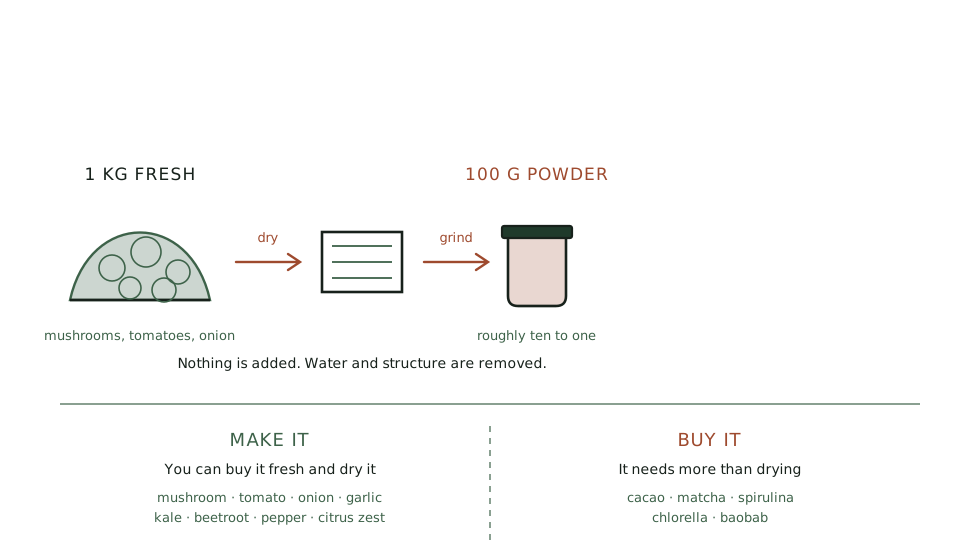
The powders hub covers the fresh to dried ratios, which are roughly ten to one for most vegetables. That is where the real reduction happens.
Safety, briefly
Two things about grinding food are worth stating, because neither is obvious.
Fine powder in the air is an irritant. Chilli, garlic, and mustard powders are the worst, and a lungful is genuinely painful rather than merely unpleasant. Wait for the dust to settle before opening, and for anything strongly pungent, open the grinder outside or under an extractor. A dust mask is not excessive if you are making chilli powder in quantity.
Blade grinders are sharp and the blades are not obvious. They sit low in a dark bowl and people reach in to scrape powder out without thinking. Use a brush or a spoon, and unplug the grinder before putting anything into the bowl.
Two smaller points. Very fine organic dust can be combustible in industrial quantities, which is not a household concern but is the reason commercial mills take it seriously. And grinding continuously heats a motor not designed for sustained running, so short bursts protect the grinder as well as the powder.
None of this makes grinding hazardous. It makes it worth doing deliberately rather than casually.
RUN THE NUMBERS
Illustrative figures. Results vary with equipment and produce.
| Step | Detail |
|---|---|
| Dryness required | Snaps cleanly, does not bend |
| Grinder fill | Half the bowl, maximum |
| Burst length | 2 to 3 seconds |
| Shake | Between every burst |
| Settle before opening | 30 seconds |
| Sieve | Once for cooking, twice for drinks |
| Loss to equipment | Around 5 percent |
| Cleaning | Grind rice, or wash a detachable bowl |
A small grinder costs very little and pays for itself against a single bag of bought mushroom powder.
Two grinders, and why
Anyone making powders regularly ends up wanting a second grinder, and it is worth understanding why before deciding whether to bother.
Some ingredients leave a permanent signature. Garlic, chilli, and strongly aromatic spices bond to the plastic parts and the seal, and no amount of rice scouring fully removes them. A grinder that has processed garlic will contribute a faint garlic note to a berry powder made in it a month later.
The practical solution is to designate one grinder for pungent ingredients and one for mild. Given how little a basic blade grinder costs, this is cheaper than the frustration of a ruined batch.
If you are keeping only one, order your work carefully. Mild before strong, sweet before savoury, and pungent last before a proper clean.
A detachable stainless bowl narrows the problem considerably, since steel holds far less than plastic and can be washed properly. That is the strongest argument for spending slightly more on the grinder itself.
WHAT GOES WRONG
A paste instead of a powder. Not dried enough. It must snap. This is the cause in the large majority of cases.
Coarse and gritty. Not sieved. One pass fixes it.
Uneven, with lumps. Overfilled bowl, or no shaking between bursts.
Clumps in the jar within a week. Ground while warm, or residual moisture. Let powder cool fully before jarring, and consider a desiccant.
Everything tastes of garlic. Grinder not cleaned. Grind rice, and order batches mild to strong.
A cloud of chilli dust in your face. Opened too soon. Wait thirty seconds.
Blades gummed with fibrous material. Stems and skins that will not break down. Sieve them out and accept that some fraction stays coarse.
DO THIS NOW
- Test a piece of your dried food by cooling it and trying to bend it. If it bends, it goes back in the machine.
- Fill the grinder no more than half full and run it in two second bursts, shaking between each one.
- Wait thirty seconds before opening the lid.
- Sieve once for cooking powders and twice for anything going into a drink, and keep the coarse fraction as flakes.
Next
For the powder that will earn its place fastest and costs almost nothing to make, see mushroom powder, the most useful jar.
Green powders need the lowest drying temperature of anything in this hub, and getting it wrong is why most home versions disappoint. Green powder that is actually green covers it.