Guide
Spirulina and Chlorella, and the Question to Ask
Algae concentrate whatever is in the water they grow in, which makes sourcing the whole question rather than a detail.
As an Amazon Associate this site earns from qualifying purchases. Links to products may be affiliate links. This costs you nothing extra and does not change what gets recommended. Nothing here is medical advice.
These are the two powders where sourcing matters more than anything else about them, and the reason is a property of the organisms rather than a failing of any particular supplier.
Algae absorb dissolved substances from their growing water efficiently. That is how they feed. It also means they concentrate whatever else is dissolved there, which makes where and how a product was grown the central question rather than a footnote.
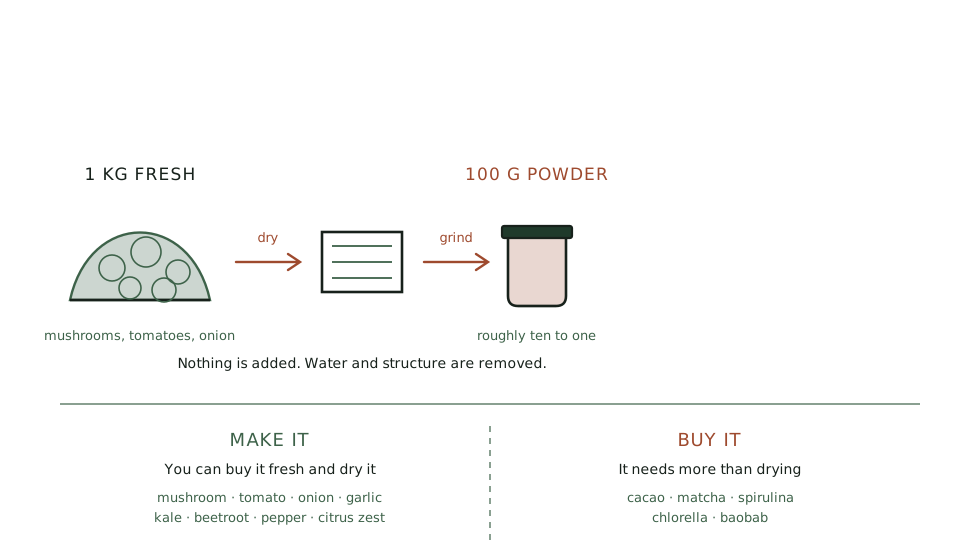
The powders hub places both firmly on the buy side, since cultivating and harvesting microalgae is not a home operation. This page covers buying them with your eyes open.
What they are
Spirulina is a cyanobacterium, sometimes described as blue-green algae, grown commercially in shallow ponds or closed systems. It is harvested, filtered, and spray dried into a deep blue-green powder.
Chlorella is a single celled green alga, grown similarly and dried into a bright green powder.
They are frequently sold together, as in a spirulina and chlorella blend, and are different organisms with different properties. The most practically relevant difference is the cell wall.
Chlorella has a tough cellulose cell wall that humans do not digest. Commercial chlorella is therefore usually processed to break it, sold as cracked cell wall or broken cell wall. Unprocessed chlorella passes through largely intact, which makes this a genuine specification rather than marketing, and a broken cell wall chlorella powder states it on the label.
Spirulina has no such wall, which is why it needs no equivalent processing and why a spirulina powder on its own is sold plain.
The sourcing question, specifically
This is the section worth reading twice.
Ask whether the product is tested, for what, and by whom. Reputable suppliers test for heavy metals and for microbial contamination, and will say so plainly. A supplier who cannot answer this clearly is telling you something useful.
The specific concerns are heavy metals and cyanotoxins. Metals because algae concentrate them from water. Cyanotoxins because some cyanobacteria produce them, and a product harvested from an open natural body of water can pick up organisms other than the intended one.
Cultivated is not the same as wild harvested. Spirulina grown in a controlled pond or closed system is a different proposition from blue-green algae collected from a natural lake, where the population is whatever is present that season. If a label describes wild harvesting from a named lake, that is worth understanding rather than assuming it means better.
Origin and traceability. Country of origin, and ideally the specific facility. Vague sourcing on a product with this profile is the wrong combination.
Certification helps and does not settle it. Organic certification addresses inputs and farming method, not contaminant testing. The two are separate questions, as the buying guide sets out for the category generally.
None of this means avoid these products. It means the question you ask is different from the question you would ask about dried kale, and it is a specific answerable question rather than a vague anxiety.
What they actually contain
Being accurate here matters, because this is a category where claims outrun evidence more than most.
Both are nutritionally dense by weight. Spirulina in particular is high in protein as a proportion of its dry mass, and both contain a range of vitamins, minerals, and pigments.
Servings are small, which changes the picture. A typical serving is a few grams. High density by weight and a small serving means the absolute contribution to a day's intake is modest for most nutrients, and this is the context usually missing from a label.
Comparisons are frequently unfair. Claims of the form "more protein than steak" compare dried powder against fresh meat by weight, which is not like for like since one has had its water removed. The same trick appears across the whole powder category.
Some specific compounds attract genuine research interest. Phycocyanin in spirulina is studied, as are various carotenoids. Research interest is not the same as an established human outcome, and much of the work is preliminary or uses isolated extracts at doses unrelated to a spoonful in a smoothie.
Vitamin B12 is the claim to be careful with. Spirulina contains B12-like compounds, and there is a longstanding question about how much of it is biologically active in humans. Anyone relying on spirulina as a B12 source, particularly on a plant based diet, should discuss that with a clinician rather than assuming a label figure settles it.
Nothing on this site is medical advice.
Who should check first
Some genuine considerations, stated once and specifically.
Phenylketonuria. Spirulina contains phenylalanine and is not appropriate for people managing PKU.
Autoimmune conditions. Immune modulating effects are discussed in the literature and the picture is not settled. Worth raising with a clinician.
Anticoagulant medication. Some green products contain meaningful vitamin K, which interacts with certain anticoagulants. Chlorella is the more relevant of the two here.
Iodine sensitivity. More an issue with seaweed products than with these two, and worth knowing if you take several green supplements.
Pregnancy. Guidance varies and errs toward caution with concentrated supplements generally.
Iron and thyroid medication timing. As with many mineral rich supplements, absorption interactions exist. Spacing doses is the usual advice.
Check your own national guidance and your own clinician. This page is a prompt to ask, not an answer.
Taste, and the practical barrier
The reason most bags of spirulina are half full a year later is not safety or efficacy. It is flavour.
Spirulina tastes strongly marine. Distinctly of the sea, slightly sulphurous, and assertive. People either accept it quickly or never do.
Chlorella is grassier and milder, closer to a very intense green powder.
Both are extremely strong colourants. A quarter teaspoon turns a smoothie opaque green, which some people find unappealing regardless of taste.
Three things genuinely help. Acid cuts it: lemon, lime, or a sour fruit. Sweetness balances it: banana, mango, or dates. And fat rounds it: yoghurt, nut butter, or coconut milk. A smoothie with all three carries a teaspoon comfortably where water would not.
Start at a quarter teaspoon rather than the full serving on the label. Working up is easy and recovering from a first attempt that tasted like a rock pool is not.
Tablets exist and solve the taste problem entirely, at a higher cost per gram.
Using them
Cold, always. Both lose colour and some compounds to heat, and neither improves for cooking. Into smoothies, juices, yoghurt, or cold dressings.
Make a paste first. Both clump aggressively in liquid. A spoonful of juice or milk worked into the powder before the rest goes in.
Blend rather than stir. These disperse poorly by hand.
In energy balls and raw bars, where dates and nut butter carry the flavour well. This is one of the better uses.
Not in baking, where heat destroys the colour and the result is a grey-green product with little to show for it.
Not in hot drinks for the same reason.
Roughly a teaspoon, which is around three grams, is a common serving. Follow the label and start below it.
Storage
Both are among the more perishable powders in this hub.
Airtight, small, dark, and cool. The pigments that make them visually distinctive are exactly what oxidises, and fading is the visible sign of decline.
Decant from a large bag. Buying in bulk and opening the same bag for a year exchanges the air inside repeatedly.
A desiccant sachet is worthwhile, as it is for any fine powder.
Note the opening date. Expect a few months of good quality once opened.
Colour is the practical indicator. Vivid deep blue-green for spirulina and bright green for chlorella. Dull, brownish, or grey means it is past its best.
Where these fit against food you grow
Worth placing honestly, since this hub argues repeatedly for making rather than buying.
Spirulina and chlorella are nutritionally dense and they arrive in very small servings. A teaspoon is a few grams. Whatever the density per hundred grams, the contribution of three grams is modest against a day of eating.
Home grown alternatives cover a good deal of the same ground at a fraction of the cost. A tray of microgreens or a jar of sprouts provides fresh green material in quantities measured in handfuls rather than teaspoons. Home made green powder from kale or nettle offers the same convenience as an algae powder at a small fraction of the price.
That is not an argument against buying these. It is an argument for knowing what they are for. They are convenient, shelf stable, and distinctive, and they are a supplement to a diet rather than a replacement for growing or eating plants.
Anyone choosing between spending on algae powder and spending on a tray of seed and a grow light would get more food from the second. Anyone who wants a teaspoon of something dense in a smoothie without growing anything is served well by the first.
Both are reasonable choices and they answer different questions.
RUN THE NUMBERS
Illustrative comparison. Specifics vary by product and supplier.
| Spirulina | Chlorella | |
|---|---|---|
| Organism | Cyanobacterium | Green alga |
| Colour | Deep blue-green | Bright green |
| Cell wall processing | Not required | Cracked cell wall needed |
| Flavour | Strongly marine | Grassy, milder |
| Typical serving | About 1 tsp | About 1 tsp |
| Key sourcing question | Testing and cultivation method | Testing and cell wall processing |
| Best used | Cold, blended, with acid and fat | Same |
| Keeps once opened | A few months | A few months |
Neither is expensive per serving. The variable worth paying for is testing and traceability rather than brand.
WHAT GOES WRONG
A bag bought and abandoned. Flavour, almost always. Start at a quarter teaspoon in something sweet and acidic.
Clumps floating in a drink. Not made into a paste first, and stirred rather than blended.
Chlorella that seems to do nothing. Possibly unprocessed cell walls. Check the label for cracked or broken cell wall.
Faded, brownish powder. Old, or stored in light. Colour is the fastest quality check.
A grey-green cake. Baked. These do not belong in anything heated.
Buying on price alone. In this specific category, testing and sourcing are what the price should reflect.
Assuming organic means tested. Two separate questions.
DO THIS NOW
- Before buying, ask the supplier directly whether they test for heavy metals and cyanotoxins, and what the answer covers.
- For chlorella, check the label says cracked or broken cell wall.
- Start at a quarter teaspoon in a smoothie containing something sour, something sweet, and something fatty.
- Decant into a small dark jar with a desiccant and write the opening date on the lid.
Next
The label reading method that applies here and to everything else you buy rather than make is in buying powders without being sold to.
For the other two powders whose processing genuinely puts them out of reach at home, see cacao and matcha.