Guide
Buying Powders Without Being Sold To
A method for reading a label rather than a list of verdicts, and the four questions worth asking about any powder you cannot make.
As an Amazon Associate this site earns from qualifying purchases. Links to products may be affiliate links. This costs you nothing extra and does not change what gets recommended. Nothing here is medical advice.
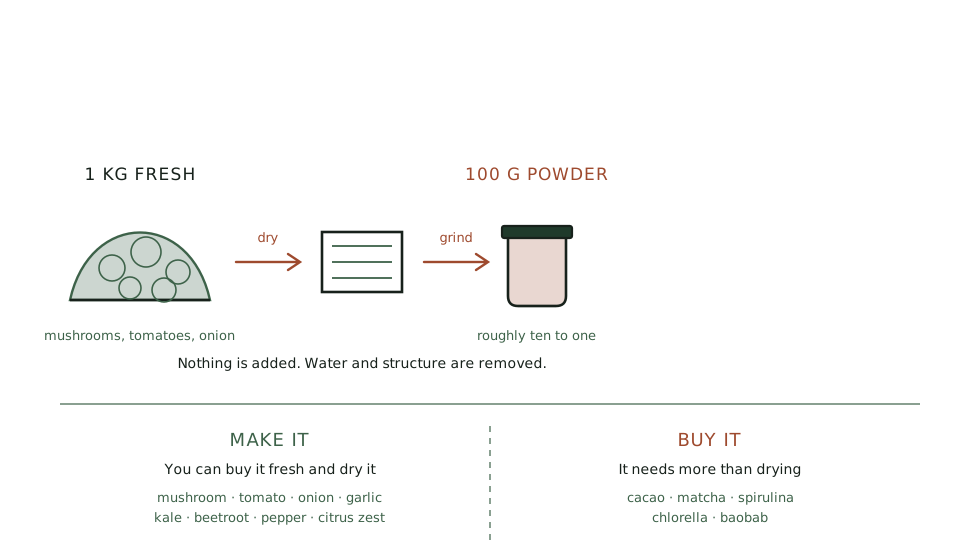
Some powders are worth buying because you cannot practically make them. Cacao needs fermentation, matcha needs shade growing and stone milling, and algae need cultivation tanks.
For those, the useful skill is reading a label, and this page gives a method rather than a list of verdicts, because products change and methods do not.
The powders hub sets out which side of the make-or-buy line each ingredient falls on. This page assumes you have decided to buy.
Read the back, not the front
The front of a package is marketing. The back is regulated, at least partly, and it is where the information lives.
Ingredients are listed by weight, in descending order. This single fact does most of the work. Anything appearing after the halfway point of a long list is present in small quantities, and anything in the last third is likely present in trace amounts that exist mainly to appear on the label.
A blend advertising forty superfoods contains meaningful quantities of perhaps three or four. The other thirty six are there so the number can be printed on the front.
Watch for proprietary blends. When several ingredients share one combined weight, you cannot know how much of any individual one is present. Manufacturers describe this as protecting a formula. It also prevents comparison, which is the practical effect.
Check the serving size before comparing anything. A claim that looks generous on a fifteen gram serving looks different when you notice most people take five.
Look for fillers. Rice flour, maltodextrin, and similar bulking agents are not harmful and they are not what you are paying for. They belong at the end of a short list, not the start.
The four questions
For any powder you are considering, these cover most of what matters.
What exactly is it? Whole dried plant, or an extract? These are genuinely different products, and a single ingredient powder such as a camu camu powder states which it is. An extract concentrates certain compounds and discards others, and a label saying "extract" without a ratio tells you very little.
Where did it come from? Country of origin, and ideally more. Vague sourcing usually means a commodity bought on price.
Has it been tested, and for what? This matters most for algae and for anything grown in soil that concentrates metals. Reputable suppliers test for heavy metals and microbial contamination and will tell you if you ask. This is a specific question rather than a general worry, and it is worth asking directly.
Is the claim comparing like with like? Covered below, and it is where most marketing lives.
If a supplier answers the first three clearly, that tells you a great deal about the fourth.
The comparison trick
The most common claim in this category takes the form "more of X than Y", and it is usually comparing a dried powder against a fresh food by weight.
That comparison is not meaningful, because the powder has had roughly ninety percent of its weight removed as water. Ten grams of any dried vegetable powder will beat ten grams of the fresh version on almost any nutrient measure, including the fresh version of itself.
A fair comparison would be like for like: dried against dried, or a realistic serving of one against a realistic serving of the other.
This does not mean the powder is worthless. It means the claim is telling you about drying rather than about the plant.
The same applies to comparisons expressed per hundred grams when nobody consumes a hundred grams. A teaspoon is about three grams.
When you see one of these, the useful mental move is to ask what a realistic serving actually delivers, and then to notice that the label often does not say.
Health claims, honestly
Several plants sold as powders have genuine research interest. Several claims made about them run well ahead of that research. Both things are true at once and the distinction is worth holding.
What tends to be reasonably supported. That these are foods containing the nutrients and plant compounds they are described as containing. That eating more plant material is broadly sensible. That some specific effects, such as dietary nitrate and exercise performance in the case of beetroot, have a reasonable body of human research behind them.
What tends to be overstated. Detoxification claims, which rarely specify what is being removed or how. Claims that a food treats or prevents a named condition. Extrapolation from laboratory or animal studies to human outcomes. Claims resting on a single study.
What is worth checking yourself. Any specific number. Nutrient figures vary enormously by growing conditions, variety, processing, and measurement method, and a single confident figure repeated across many sites usually traces back to one source.
Nothing on this site is medical advice. Powders are concentrated, some interact with medication, and anyone taking one for a specific health reason should raise it with a clinician rather than with a website or a manufacturer.
Price, and what it does not tell you
Price correlates poorly with quality in this category, which is unusual and worth knowing.
A substantial share of the premium on many powders goes to packaging, brand, and marketing rather than to the material. The same commodity powder appears in a plain bulk bag and in an expensively designed pouch at several times the price.
Where price does track quality. Matcha, where grade is a real distinction. Anything requiring genuine processing, such as properly fermented cacao. Products carrying real testing and certification, which costs money.
Where it usually does not. Single ingredient vegetable and fruit powders, which are commodities. Most green powders. Anything where the differentiator is the label design.
Blends are usually poor value for the reason given above: a long ingredient list where most items are traces, at a price reflecting the length of the list.
Buying two or three single ingredients and combining them yourself costs less, gives you control over the ratio, and lets you leave out the things you do not want.
Where to buy
Bulk food suppliers often stock the same material as branded products at a lower price, in plainer packaging. Single ingredient powders such as a baobab fruit powder are the easiest place to compare, since there is only one thing in the bag.
Specialist importers are usually the right route for matcha and for anything where origin and grade matter.
Health food shops vary enormously. The useful signal is whether staff can answer the four questions.
Online marketplaces carry everything including a wide range of quality. The seller matters as much as the product.
Whatever the source, buy a small quantity first. Powders are strongly flavoured and a large bag of something you dislike is a genuine waste.
Storage once bought
Bought powders age exactly as home made ones do, and often arrive having already spent time in a warehouse.
Decant from a large bag into a small airtight jar for daily use and keep the remainder sealed. Every opening of the main container exchanges the air inside.
Dark and cool. Green powders in particular fade quickly in a clear container on a shelf.
Note the date of opening on the jar, since most of these are best within months rather than years once air has reached them.
A desiccant sachet is worthwhile for anything you will keep for more than a couple of months.
Certifications, and what each one covers
Labels carry a range of marks and they answer different questions, which is worth knowing before paying a premium for one.
Organic. Describes how the crop was grown and which inputs were permitted. A meaningful production standard. It does not guarantee heavy metal testing, since metals can be present in soil regardless of farming method, and it says nothing about processing quality.
Non-GMO. Speaks to genetics. For most of the plants in this category it rarely distinguishes one supplier from another.
Fair trade and similar. Addresses labour and price paid to growers. Relevant for cacao in particular, and unrelated to product quality.
Third party tested. The one that addresses contamination directly, and the least standardised of the marks. Ask what was tested, by whom, and how often. A supplier who can answer is telling you something; one who deflects is also telling you something.
Ceremonial or culinary grade, for matcha. A real distinction reflecting leaf selection and milling, not only marketing, and it genuinely affects flavour. a ceremonial grade matcha in a small sealed tin and a culinary grade matcha for lattes and baking sit either side of it.
Raw. Usually means processed below a stated temperature. Whether that matters depends entirely on the ingredient and the claim attached.
None of these is a substitute for the others, and a product can carry three while telling you nothing about the fourth. Read them as separate answers to separate questions.
RUN THE NUMBERS
A checklist rather than prices, since prices vary too widely to be useful.
| Check | What it tells you |
|---|---|
| Ingredient order | Anything past halfway is a small quantity |
| Proprietary blend | You cannot know the individual amounts |
| Serving size | Whether the headline claim is realistic |
| Whole plant or extract | Two different products |
| Country of origin | Whether sourcing is considered or commodity |
| Testing disclosed | Especially important for algae |
| Comparison basis | Dried against fresh is not like for like |
| Filler position | Should be at the end of a short list |
The fastest single filter: if the ingredient list is longer than five items, you are probably paying for the list.
WHAT GOES WRONG
Buying a forty ingredient blend. Most of it is trace quantities and you cannot adjust the ratio.
Comparing on the front of the pack. The comparison is usually dried against fresh.
Assuming price means quality. It often means packaging.
Buying a large bag of something untried. Powders are assertive. Buy small first.
Ignoring the extract question. A whole plant powder and an extract are not interchangeable.
Not asking about testing. For algae in particular, this is the one specific question worth asking.
Storing the bag it came in on a shelf. Decant, keep dark, keep small.
DO THIS NOW
- Turn any powder you own to the back and read the ingredient list in order. Note where the halfway point falls.
- Work out what a realistic serving actually is, and re-read the front-of-pack claim against that.
- For any algae product, ask the supplier directly whether they test for heavy metals.
- Decant into a small dark jar, write the opening date on it, and keep the rest sealed.
Next
For the two powders most worth making rather than buying, see mushroom powder, the most useful jar and green powder that is actually green.
Home made green powder is the direct alternative to the most heavily marketed bought product in this category, and the temperature rule is what makes it work.