Guide
Shelf or Stackable: Choosing a Dehydrator
Two designs, one real difference, and the accessories that matter more than the machine you pick.
As an Amazon Associate this site earns from qualifying purchases. Links to products may be affiliate links. This costs you nothing extra and does not change what gets recommended. Nothing here is medical advice.
Two designs cover almost every home dehydrator, and they differ in exactly one way that matters: where the fan sits and therefore how air moves through the food.
Everything else in the marketing follows from that or is noise. Once you understand the airflow difference, the decision takes about a minute.
The one real difference
Shelf or box machines put the fan at the back, behind a vertical wall of trays. Air is pushed forward horizontally, passing across every shelf at roughly the same time and the same temperature. Trays slide in and out like drawers.
Stackable machines put the fan in the base or the lid, and air travels vertically through a column of stacked rings. Each tier receives air that has already passed through the tier before it.
That single geometric difference produces every practical consequence below.
What follows from it
Evenness. Shelf machines dry evenly across all trays because each shelf gets its own supply of moving air. Stackable machines dry unevenly, with the tier nearest the fan finishing first and the far tier lagging. Rotating tiers partway through largely corrects this and it is a real chore on an eight hour batch.
Capacity behaviour. A shelf machine has fixed capacity, and running it half full is inefficient but harmless. A stackable machine gains capacity by adding tiers, and every added tier makes the evenness problem worse. Manufacturers often advertise a maximum tier count that produces poor results in practice.
Access. Shelf trays pull out individually, so you can check or remove one without disturbing the rest. Checking the bottom tier of a stack means lifting everything above it, which is genuinely annoying at hour six.
Storage. Stackable machines nest inside themselves and go in a cupboard. Shelf machines are a box and stay a box.
Noise and cost. Stackable machines are cheaper. Shelf machines with rear fans tend to run quieter, since the fan is larger and turns more slowly.
Which to buy
Buy stackable if you are starting out, drying occasionally, short on storage space, or unsure whether this will become a habit. a stackable dehydrator with a base-mounted fan is the pattern, and it will produce results indistinguishable from an expensive machine on a single tier. Accept that you will rotate trays.
Buy shelf if you dry regularly, run full loads, or want to start a batch and walk away. a stainless shelf dehydrator with rear-fan airflow is the standard form and the rotating chore disappears entirely. For anyone drying a harvest rather than a snack, a larger six tray machine adds capacity without changing the design.
Buy neither yet if you have an oven that holds a low temperature. Run three batches in it, learn whether you enjoy this, and buy properly afterwards. The oven method is covered on the drying hub.
The upgrade path most people follow is stackable first, then shelf once the habit is established. That is a sensible sequence rather than a wasted purchase, since a stackable machine resells easily and costs little to begin with.
The specifications that matter
Four things on a spec sheet are worth reading. The rest is decoration.
Adjustable temperature, with a usable low end. Anything without a thermostat is unsuitable, because herbs need around forty degrees and fruit needs closer to sixty. A machine with a single fixed setting will scorch herbs and case harden fruit. Check the minimum, not the maximum.
A timer with auto shutoff. Batches run eight to twelve hours and often overnight. A timer is the difference between a machine you start before bed and one you have to stay awake for.
Stainless trays, or the option of them. Plastic mesh stains, warps at temperature over time, and holds odours between batches. Onion followed by apple is a genuinely unpleasant discovery. stainless replacement trays solve this for machines that ship with plastic.
Rear fan placement, on shelf machines. Some box designs put the fan at the bottom, which reintroduces the vertical airflow problem in a horizontal case. Rear is what you want.
Two things advertised heavily that matter less. Wattage tells you very little on its own, since airflow design matters more than raw power. And tray count is meaningless without tray area, so compare square footage rather than number of trays.
Accessories that matter more than the machine
Honest ranking: a cheap dehydrator with these beats an expensive one without them.
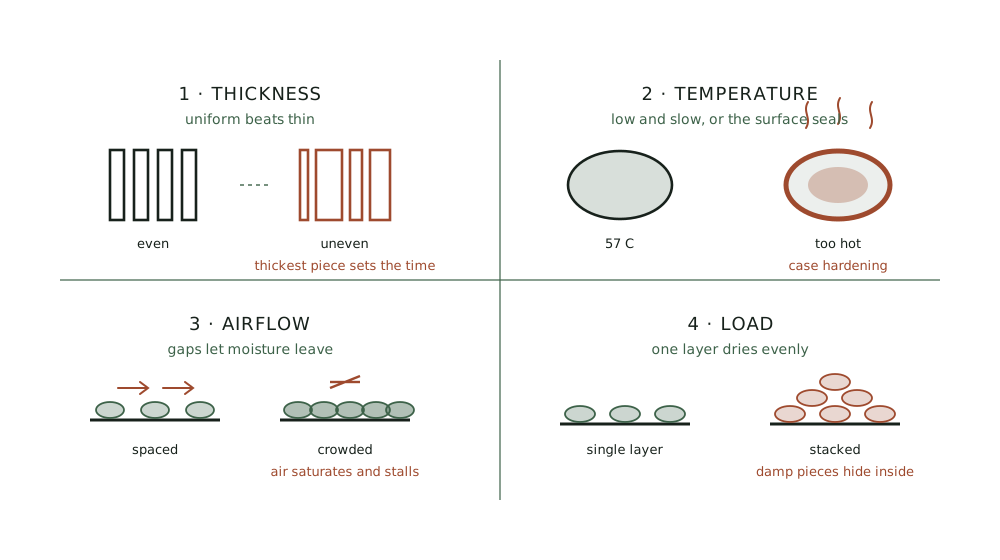
A mandoline. Uniform thickness is the largest single quality variable in drying, because the thickest piece sets the drying time while everything thinner overdries waiting for it. a handheld mandoline with adjustable thickness handles most household work and lives in a drawer. a full size mandoline with a guard and cut-resistant gloves is the fuller version with a hand guard and cut-resistant gloves, which is what you want if you are slicing several kilograms at a time.
Use the guard every single time. Mandoline injuries are common, serious, and completely preventable.
Solid sheets. Fruit leather, small items, and anything sticky need a solid surface rather than mesh. Most machines include one and you will want more.
A kitchen scale. Weight loss is the most reliable doneness measure available, far better than judging by eye, and it teaches you the real yield ratio for each food.
Glass jars in useful sizes. For conditioning and for storage. Clear glass matters for conditioning, since watching for condensation is how you catch an underdried batch.
Running costs and where it lives
Two practical considerations get overlooked and both affect whether the machine stays in use.
Electricity. A dehydrator draws modest power and runs for a long time, which is an unfamiliar combination. A typical machine uses roughly what a couple of old incandescent bulbs would, for eight to twelve hours. Over a year of weekly batches this is small, and it is not nothing. Running batches overnight suits variable tariffs where those exist.
Noise and heat. The machine runs continuously and produces both. A dehydrator in a small kitchen makes the room warm and hums steadily, which is pleasant in November and less so in July. Many people run theirs in a utility room, a garage, or a spare corner for exactly this reason.
It also smells. Drying onion perfumes a house thoroughly. Drying apple is delightful. Neither is a problem and both are worth anticipating before you site the machine next to a bedroom.
Where it lives decides how often it gets used, exactly as with any appliance. A machine that lives in a cupboard gets used until the novelty fades. Something this large usually cannot stay on a counter permanently, which is a genuine argument for the stackable design, since it nests down into a much smaller object between batches.
Capacity, realistically
The most common sizing mistake is buying for the imagined harvest rather than the actual one.
A five tray machine handles roughly two to three kilograms of prepared produce, which is around six apples per tray, or one large tray of herbs, or a batch of jerky for a household.
That is enough for weekly snacking, for drying a herb harvest, and for working through a glut over several days. It is not enough to process a bulk order of tomatoes in one session, and people who try discover that running four consecutive batches is a two day commitment.
If you have a garden or buy in bulk seasonally, size up. If you are drying apples for lunchboxes, five trays is plenty and a larger machine will sit half empty.
One practical note: a full machine takes considerably longer than a half full one. Times quoted in manuals assume moderate loads.
RUN THE NUMBERS
Illustrative comparison only. Prices vary by region and this is not a promise about your results.
| Stackable | Shelf or box | |
|---|---|---|
| Fan position | Base or lid | Rear |
| Airflow | Vertical, through tiers | Horizontal, across shelves |
| Evenness | Needs rotation | Even, no rotation |
| Capacity | Add tiers, at a cost to evenness | Fixed |
| Access to one tray | Lift everything above | Pull it out |
| Storage | Nests, goes in a cupboard | Permanent box |
| Entry cost | Lower | Higher |
| Best for | Starting out, occasional use | Regular use, full loads |
The honest summary: both dry food well. You are choosing between a lower price with a rotation chore and a higher price without one.
Buying used
Dehydrators appear constantly on second hand listings, usually bought with enthusiasm and used twice, which makes them one of the better used-appliance buys.
Check three things. That every tray is present, since replacements cost a surprising amount and some models are discontinued. That the thermostat actually holds a setting, which you can test by running it empty for twenty minutes with a thermometer inside. And that the trays are not badly warped, since warped trays sit unevenly and disrupt airflow.
Plastic trays that have gone brittle or yellowed are a reasonable haggling point rather than a dealbreaker, since stainless replacements are available for most common models.
Run the fan before committing. A bearing on the way out is audible immediately and is not worth any discount.
WHAT GOES WRONG
Buying a machine with no thermostat. It will scorch herbs and case harden fruit. This is the one specification that is not optional.
Adding every tier the box allows. Stackable machines advertise maximum capacity and perform well below it. Two or three tiers dry far better than six.
Plastic mesh that holds onion smell. Replace with stainless or silicone. This happens to everyone eventually.
Buying big before proving the habit. A large machine that gets used twice is worse than a small one used weekly.
No mandoline. The most common reason for uneven batches, and the cheapest thing on this page to fix.
DO THIS NOW
- Check the minimum temperature on any machine you are considering. If it will not go to forty degrees, herbs are off the menu.
- Confirm it has a timer with auto shutoff before comparing anything else.
- Buy a mandoline at the same time as the machine, not later. It matters more than the choice between the two designs.
- If you own an oven that holds a low temperature, run three batches in it before spending anything.
Next
Once the machine is chosen, fruit is the place to start. Drying fruit properly covers thickness, acid pre-treatment, and the doneness test.
Vegetables need one extra step that fruit does not. Drying vegetables and the blanching question explains why, and which ones can skip it.